3 September 2018
Seymour Hersh, the investigative journalist who played a leading role
in exposing the 1968 My Lai massacre and the Bush administration’s
torture of prisoners at Abu Ghraib, has published a long-awaited
autobiography.
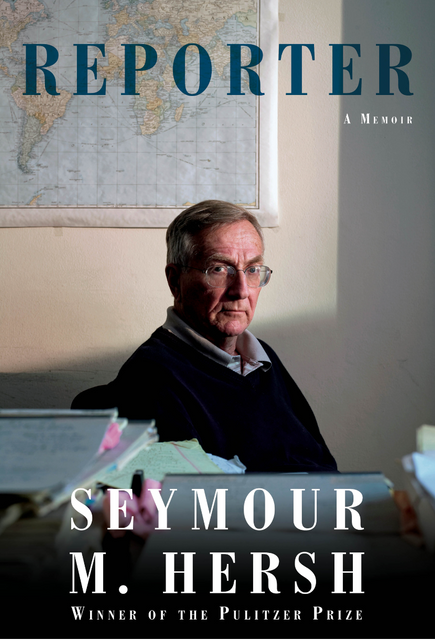
Seymour Hersh’s Reporter
Hersh is one of the world’s most renowned investigative journalists.
But despite his decades of journalistic experience, which won him
numerous awards, including the Pullitzer Prize, two National Magazine
Awards and five George Polk Awards, Hersh has been all but ostracized by
the American press.
No prominent American, or for that matter British, newspapers or
periodicals, will publish his stories. And each one of his exposures are
met with vituperative denunciations, or worse—silence.
But there is nothing defensive about his memoir. Instead, Hersh has
written the story of his own colorful life the same way he writes his
articles. The book is a clear, gripping narrative from beginning to end,
describing, first-hand, the revelation of some of the greatest crimes
since the second world war.
The book’s title,
Reporter, reflects its contents. The
memoir is not, at first glance, a rebuttal to his contemporary critics,
who call him an apologist for the Putin government because he dares
question the CIA’s narrative of foreign policy; rather, he often puts
the most generous interpretations on the actions of his fellow
journalists.
In narrating his life, he is narrating what a reporter does,
beginning with a profound skepticism about everything, most of all
official statements. If the book has a leitmotif, it’s the phrase, “If
your mother says she loves you, check it out,” meaning that the job of
the reporter is to question and independently verify everything he
hears.
The clear, but unstated, allegation of Hersh’s book is: “I am a real reporter, and my critics are not.”
Hersh phrases it more diplomatically in his preface:
“I am a survivor from the golden age of journalism,” he
writes. “There were no televised panels of ‘experts’ and journalists on
cable TV who began every answer to every question with the two deadliest
words in the media world—’I think.’”
“The newspapers of today far too often rush into print with stories
that are essentially little more than tips, or hints of something toxic
or criminal. For lack of time, money, or skilled staff, we are besieged
with ‘he said, she said’ stories in which the reporter is little more
than a parrot. I always thought it was a newspaper’s mission to search
out the truth and not merely to report on the dispute.”
“My career,” Hersh writes, “has been all about the importance of
telling important and unwanted truths and making America a more
knowledgeable place.”
Seymour Hersh was born to a lower-middle-class Jewish family in
Chicago, where he helped run the family’s dry cleaning business. After
graduating from the University of Chicago, he began work at local
newspapers first as a copyboy, then as a crime reporter. He moved on to
work as a correspondent for United Press International in South Dakota,
before working as a Chicago and Washington correspondent for the
Associated Press.
His first national break came from his reporting on the Pentagon’s
secret program to develop chemical and biological weapons, of which
Agent Orange, the chemical defoliant deployed on a massive scale in
Vietnam, was a product. Hersh’s research was vindicated by a March 14,
1968 chemical weapons test at Utah’s Dugway Proving Ground, which led to
the deaths of over 6,000 sheep. Hersh noted, “it took the army more
than a month to acknowledge responsibility for the macabre event, and it
did so only after a fact sheet sent to a Utah senator for his personal
use was inadvertently made public by an aide.”
Hersh’s reporting led to an offer to serve as the press secretary for
Senator Eugene McCarthy’s unsuccessful 1968 campaign for the Democratic
presidential nomination. Hersh was a poor fit for job; he returned to
journalism and to the biggest story of his life.
In October 1969, Hersh received a tip that the US Army was in the
process of court-martialing a soldier for killing 72 Vietnamese
civilians. He spent days trying to find the soldier’s name, until a
recently-promoted general he knew casually dropped it in conversation:
William Calley.
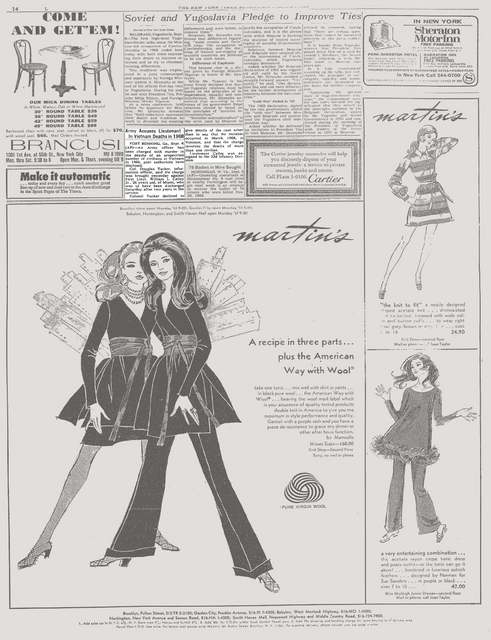
The New York Times did its best to bury the story of William Calley’s court-martial
Now that Hersh had a name, he found the truth lying in plain sight, which had been concealed by the
New York Times and the television evening news treating the matter as a routine military disciplinary procedure.
“No one in my profession asked any questions at the time,” Hersh
wrote. “News of the charges against Calley even made the
Huntley-Brinkley evening news, a popular and highly regarded show on
NBC, with the network’s Pentagon correspondent simply parroting the
official press release.”
But unlike his peers, who were content to toe the Pentagon line,
Hersh set out to find Calley. Possessing the ability to strike up a
rapport with seemingly anyone, Hersh, who had served in the army for six
months, managed to drink his way into the confidence of Calley’s
roommates at Fort Benning, and then earned the trust of Calley himself.
Hersh tracked down other witnesses and participants in the massacre.
He describes how he found a soldier named Paul Meadlo, who “had
mechanically fired clip after clip of rifle bullets, at Calley’s orders,
into groups of women and children who had been rounded up amid the
massacre.”
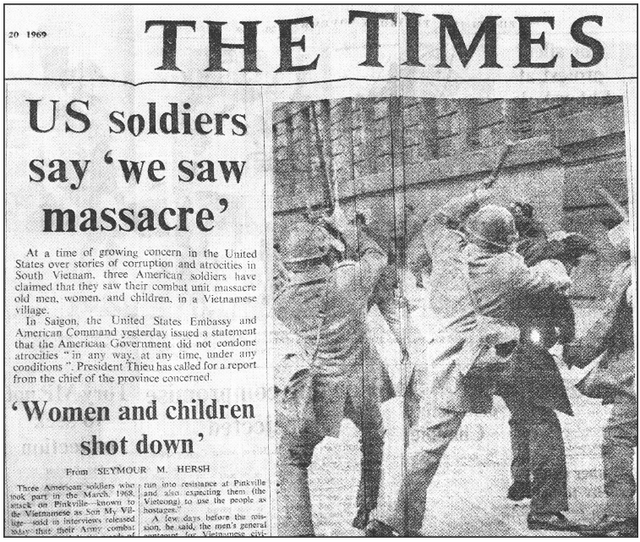
Hersh writes: “The major play given my second story on My Lai by the London Times influenced many American newspapers to reconsider my stories, which they had initially rejected or downplayed.”
When Hersh arrived at Meadlo’s home, his mother told the reporter “I sent them a good boy, and they made him a murderer.”'
Hersh recalled: “He’d been asked to stand watch over a large group of
women and children, all terrified survivors of the carnage, who had
been gathered in a ditch. Calley, upon arriving at the ditch, ordered
Meadlo and others to kill all. Meadlo did the bulk of the killing,
firing seventeen-bullet clips—four or five in all, he told me—into the
ditch, until it grew silent.”
In a note he penned to editor Bob Loomis as he was writing his
book-length account of the My Lai massacre, Hersh reveals a fundamental
truth about the Vietnam war: that it was a crime not just against the
Vietnamese, but against the soldiers who were sent into a criminal war
to commit unspeakable acts.
Some will claim that I have attempted to exploit some
dumb, out of service, overly talkative GIs. But few men are exposed to
charges of murder… it is not a “naming names and telling all affair.” In
fact, one of the strengths is that discriminating readers will know how
much more I know—and did not tell. I’m convinced that to give the name
and hometown of a GI who committed rape and murder that day, or one who
beheaded an infant, would not further the aim of the book. It is an
exposé, but not of the men of Charlie Company. Something much more
significant is being put to light … Both the killer and the killed are
victims in Vietnam; the peasant who is shot down for no reason and the
G.I. who is taught, or comes to believe, that a Vietnamese life somehow
has less meaning than his wife’s, or his sister’s, or his mother’s.
In one of the rare occasions when Hersh opens up about his own feelings, he writes:
One GI who shot himself in the foot to get the hell out
of My Lai told me of the special savagery some of his colleagues—or was
it himself?—had shown toward two- and three-year-olds. One GI used his
bayonet repeatedly on a little boy, at one point tossing the child,
perhaps still alive, in the air and spearing it as if it were a
papier-mâché piñata. I had a two-year-old son at home, and there were
times, after talking to my wife and then my child on the telephone—I was
often gone for many days at a time—I would suddenly burst into tears,
sobbing uncontrollably. For them? For their victims? For me, because of
what I was learning?
Hersh’s investigation revealed that the US government had massacred
between 347 and 504 unarmed people, who were referred to as “Orientals”
in the official indictment. Only one person, Calley, was sentenced for
the crimes. He ended up serving only three and a half years under house
arrest.
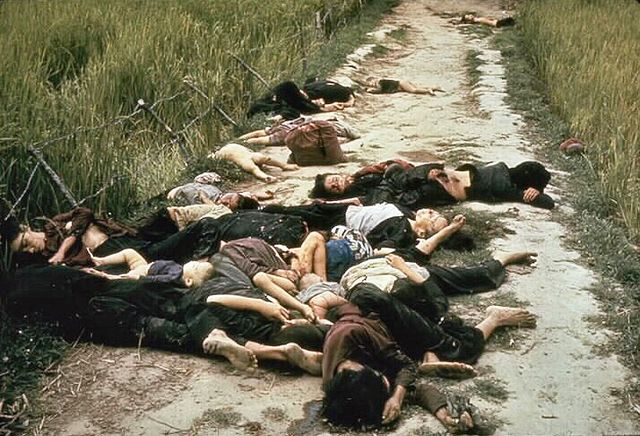
The aftermath of the My Lai massacre, showing mostly women and children dead on a road
The massacre was, as one of the soldiers who witnessed it told Hersh,
a “Nazi-type thing.” The event showed showed, in other words, that
“Americans do not fight war more honorably or more sanely than the
Japanese and Germans did in World War II.”
Hersh was subsequently hired by the
New York Times and went
on to carry out extensive reporting on the Watergate scandal, including
his revelation of widespread domestic wiretapping and massive government
infiltration of anti-war groups by the Nixon White House, as well as
the role of Secretary of State Henry Kissinger and the CIA in the
September 11, 1973 coup that overthrew the government of Salvador
Allende.
Hersh left the
New York Times in 1975, when he learned that
the editorial board had secretly met with Gerald Ford and agreed to keep
secret US government involvement in assassinations, and then conspired
to keep Hersh from learning about it.
He went on to investigate corporate corruption, the downing of Korean
Air Flight 007 and Israel’s development of nuclear weapons.
Following the September 11, 2001 terror attacks, Hersh devoted all of
his efforts to investigating Middle East policy. His reporting quickly
led him to the secret military plans to invade Iraq, which were later
sold to the public based on false claims about Iraqi “weapons of mass
destruction.”
Hersh writes:
I knew, for example, that a decision had been made in
late 2001—driven by neoconservative Republicans in and out of the
government—to pull many special operations troops from Afghanistan, and
from the hunt for bin Laden, in order to begin building up toward an
all-out invasion of Iraq. The argument for doing so was that Saddam
Hussein posed a more immediate threat because he had the capability to
make the bomb. That was total nonsense. I knew from my earlier reporting
on UNSCOM, the United Nations team whose mission had been to root out
any weapons of mass destruction in Iraq, that the 1991 American bombing
in the First Gulf War had demolished the Iraqi nuclear weapons
infrastructure, which had not been rebuilt. For the next fifteen
months—until America began the Second Gulf War in March 2003—I wrote
again and again about the distortion of intelligence and official lying
about weapons of mass destruction (WMDs) in Iraq that paved the way for
the war.
Hersh then goes on to quote from a secret US policy document whose
existence, up to the publication of his book, had only been hinted at:
The document declared that the war to reshape the Middle
East had to begin “with the assault on Iraq. The fundamental reason for
this … is that the war will start making the U.S. the hegemon of the
Middle East. The correlative reason is to make the region feel in its
bones, as it were, the seriousness of American intent and
determination.” Victory in Iraq would lead to an ultimatum to Damascus,
the “defanging” of Iran, Hezbollah, Hamas, and Arafat’s Palestine
Liberation Organization, and other anti-Israeli groups. America’s
enemies must understand that “they are fighting for their life: Pax
Americana is on its way, which implies their annihilation.”
It was this megalomaniacal policy, Hersh explains, which manifested
itself in the criminal methods used by Washington in waging the war in
Iraq. Among the horrific products of this war of aggression was the
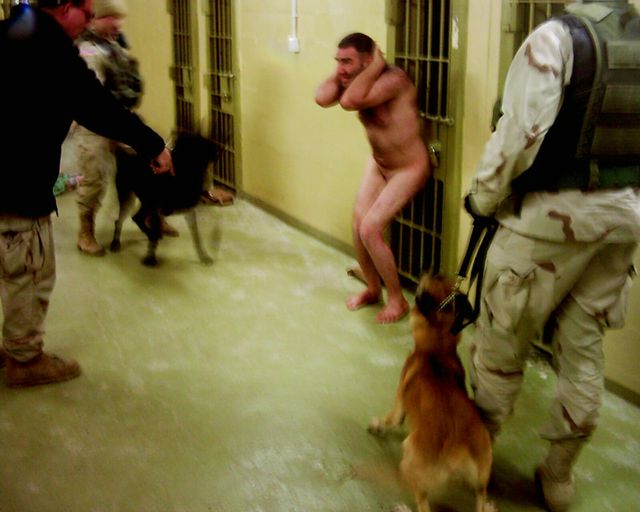
torture of prisoners at Abu Ghraib, which Hersh helped expose in April
2004.
As with My Lai, Hersh picked up and exposed a story that leading news
agencies had sought to bury. After learning that CBS’s “60
Minutes” program was in possession of the infamous photos of torture at
Abu Ghraib but was refusing to publish them, Hersh threatened to
publish the photos in the
New Yorker and expose CBS’s
self-censorship. The network, grudgingly, published the photos, dealing a
devastating blow to US pretensions of “liberating” the Middle East with
the invasion of Iraq.
A photograph taken at Abu Ghraib prison in Iraq in 2004
But while Hersh was still viewed as within the journalistic
mainstream in 2004, what turned him into a pariah was the shift in
American foreign policy reflected in his March 5, 2007 essay “The
Redirection,” in which he argued that the Bush Administration, setting
its sights on a conflict in Iran and Syria, had set about the
“bolstering of Sunni extremist groups … sympathetic to Al Qaeda.”
This policy was masterminded by Vice President Dick Cheney, but it
came into its own under Obama, who, seizing upon political upheavals
throughout the Middle East in 2011, worked with Saudi Arabia and Turkey
to funnel money to Syrian “rebel” groups with close ties to Al Qaeda.
Hersh documented the mechanism of this “ratline,” and the consternation
it caused within sections of the American military, in his 2015 essay,
“Military to Military.”
But the tide turned against the US and Saudi-backed insurgency with
the intervention of Russia in 2015, which, together with Iran, helped
bolster the Syrian government, which is now on the verge of retaking all
of Syria.
To make the case for greater US intervention in the face of these
reversals, the US government seized upon a series of alleged chemical
weapons attacks, including incidents in Ghouta in 2013 and Khan Shaykhun
in 2017. Hersh thoroughly debunked the American claims in both attacks.
His 2013 essay was published in the London
Review of Books, which subsequently rejected his 2017 essay, forcing him to publish it in the German
Welt am Sonntag.
Reviews of Hersh’s memoir in the
New York Times and
Washington Post
have created an artificial wall between his “early” and “later”
periods. His early work is inevitably praised as the acme of journalism.
His later work is calumniated as enemy propaganda and “fake news.”
But the fact is that Seymour Hersh has not changed: American politics
and the media have. Under the Bush years, it was still permissible
within the corporate media to criticize American foreign policy, however
few and far between were such voices.
But after Obama’s 2008 victory, the entire American political
establishment, including its middle-class “left” wing, embraced military
escalation in the Middle East, and the media followed suit.
The criminality, along with the flagrant and filthy lying that tarred
the Nixon and Bush administrations, have not only been adopted as
standard practice by the whole political establishment, but have been
embraced by the media.
Hersh has continued to expose these crimes and lies and because of it
has been treated as a pariah in official American politics.
We do not share many of Seymour Hersh’s views, including his appeals
to what he calls the reasonable sections of the US military and
intelligence apparatus for a change in US foreign policy. But, as the
book’s title implies, he is a genuine reporter; he knows the difference
between the truth and a lie and works to expose it before the world
public.
……………………………
Book TV – Seymour Hersch – (1:30 min)
https://www.youtube.com/watch?v=akngHZHi5KI
Society of the Silurians ~ Seymour (Sy) Hersh ~ 20 June 2018
(1:04:24 min)
https://www.youtube.com/watch?v=kbYKLfwV7gU


 .
.