(1243 – King Louis IX of France Ordered the Burning of 12,000 Jewish Talmuds)
Thirteenth Century Holy Warrior King Louis of France
In 1296 the deceased former head of the French state became a
recognized saint of the Catholic Church. King Louis the Ninth said he
was inspired in all of his actions as king by his Christian zeal.
He fought in wars against Islam, and he fought in France against
blasphemy and Jewish people. Blasphemy, doubting the teachings of the
Catholic Church, was severely punished by Saint Louis government. The
punishments for those who thought differently from Saint Louis and the
Church was mutilation of the tongue and lips.
Saint Louis opposed the payment of interest on money loans as
something forbidden by the Bible. He also outlawed gambling and
prostitution. He spent great sums of money for ‘relics’ of Christ and
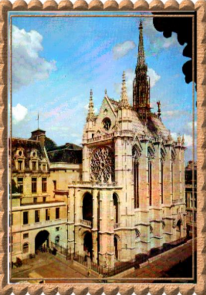
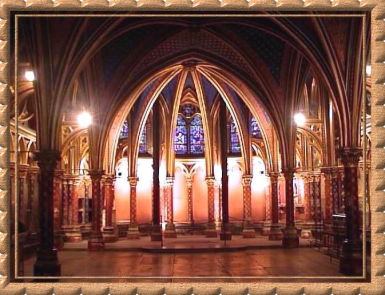
built a special church to hold them – the Sainte-Chapelle.
Saint Lois expanded the scope of the Religious Police, the
Inquisition, to target Jewish people and ordered the burning of
collections of Jewish books including The Talmud.
Saint Louis took up arms against Muslims to bring Christianity back
to the Middle East and North Africa. He died fighting against Islam in
North Africa.
Much of what is known of Louis’s life comes from
Jean de Joinville‘s famous
Life of Saint Louis.
Joinville was a close friend, confidant, and counselor to the king, and
also participated as a witness in the papal inquest into Louis’ life
that ended with his canonization in 1297 by
Pope Boniface VIII.
The popes in Rome had encouraged holy wars against the Islamic empire
in the Middle East and North Africa and King Louis heeded the call.
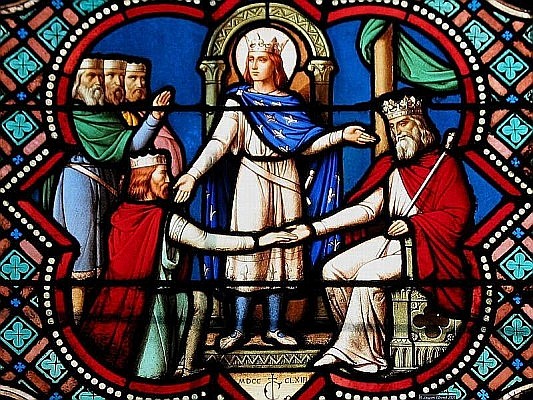
Louis was born in 1214 to a Castilian mother and a Frankish father.
Louis was 12 years old when his father died in 1226. He was crowned king
within the month at
Reims cathedral. Because of Louis’s youth, his mother,
Blanche of Castile, ruled France as
regent during his minority. His mother was a fanatical Christian.
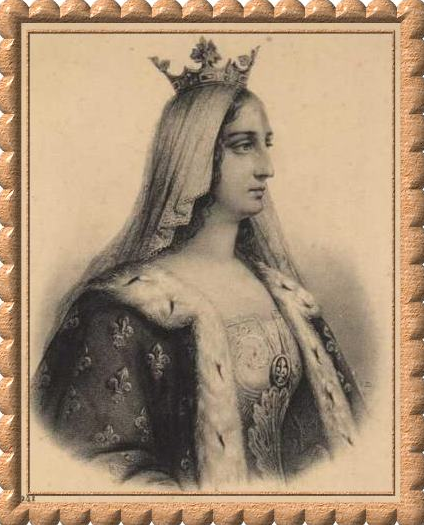
(Blanche of Castile.)
Louis’ mother had him trained him to be a ruthless leader and a intolerant Christian. She used to say:
I love you, my dear son, as much as
a mother can love her child; but I would rather see you dead at my feet
than that you should ever commit a mortal sin.
No date is known for the beginning of Louis’s personal rule. His
contemporaries viewed his reign as co-rule between the king and his
mother, though historians generally view the year 1234 as the year in
which Louis began ruling personally, with his mother assuming a more
advisory role. She continued to have a strong influence on the king until her death in 1252.
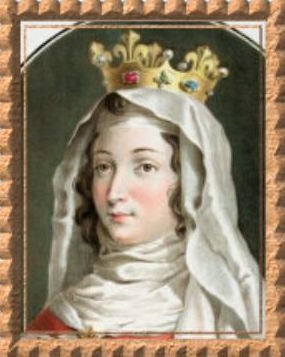
(Margaret of Provence)
In 1234, Louis married
Margaret of Provence.
The new queen’s religious zeal made her a well suited partner for the
king. He enjoyed her company, and was pleased to show her the many
public works he was making in Paris, both for its defense and for its
health. They enjoyed riding together, reading, and listening to music.
This attention raised a certain amount of jealousy in his mother, who
tried to keep them apart as much as she could. They had eleven
children, five sons and six daughters. This line continued in power in
France for five hundred years. In 1793, as the guillotine fell on King
Louis XVI, Abbe Edgeworth said: “Son of Saint Louis, ascend to Heaven!”
Saint Louis publicized his acts of charity. Soldiers rounded up
beggars who were fed from his table, he ate their leavings, washed their
feet, ministered to the wants of the lepers, and daily fed over one
hundred poor. He founded many hospitals and houses: the House of the
Filles-Dieu for reformed prostitutes; the
Quinze-Vingt for 300 blind men, hospitals at Pontoise, Vernon, Compiégne.
[25]
St. Louis installed a group of the
Trinitarian Order of Catholic clergy in his
château of Fontainebleau.
He chose Trinitarians as his chaplains, and was accompanied by them on
his crusades. In his spiritual testament he wrote: “My dearest son, you
should permit yourself to be tormented by every kind of martyrdom before
you would allow yourself to commit a mortal sin.” Basically saying
“Follow church rules.” At the time the clergy were like a second
government.
Saint Louis bought “the Crown of Thorns” supposedly worn by Jesus and
other holy relics from the Eastern Emperor at Constantinople. He sent
two Dominican friars to bring these sacred objects to France, and,
attended by an impressive train, he met them at Sens on their return. To
house the relics, he built on the island in the Seine named for him,
the shrine of Sainte-Chapelle, one of the most beautiful examples of
Gothic architecture in existence. Since the French Revolution it stands
empty of its treasure.
The
Sainte Chapelle, a perfect example of the Rayonnant style of
Gothic architecture, was erected as a shrine for the
Crown of Thorns and a supposed fragment of the
True Cross, phony
relics of the time of
Jesus. Louis purchased these in
1239–
41 from Emperor
Baldwin II of the
Latin Empire of
Constantinople, for the exorbitant sum of 135,000
livres
(the chapel, on the other hand, cost only 60,000 livres to build). This
purchase should be understood in the context of the extreme religious
fervor that existed in Europe in the 13th century. The purchase
contributed greatly to reinforcing the central position of the king of
France in western Christendom, as well as to increasing the renown of
Paris, then the largest city of western Europe. During a time when
cities and rulers vied for relics, trying to increase their reputation
and fame, Louis IX had succeeded in securing the most prized of all
relics in his capital. The purchase was thus not only an act of
devotion, but also a political gesture: the French monarchy was trying
to establish the kingdom of France as the “
new Jerusalem.”
Saint Louis loved sermons, heard two Masses daily, and was
surrounded, even while traveling, with priests chanting the hours. He
was said to be most happy in the company of priests talking about the
Christian religion and God.
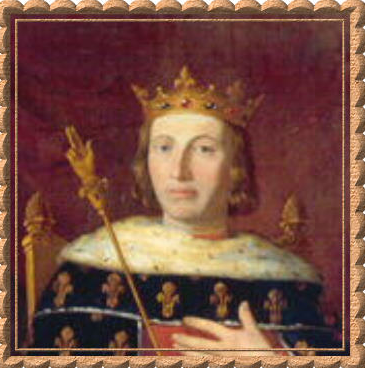
His friend and biographer, the Sieur de Joinville, who accompanied
him on his first crusade to the Holy Land, relates an anecdote to
illustrate how religious the king was.
“What is God?”King Louis once asked him.
Joinville replied, “Sire, it is that which is so good that there can be nothing better.”
“Well,” said the King, “now tell me, would You rather be a leper or commit a mortal sin?”
The spectacle of the wretched lepers who wandered along the highways
of medieval Europe might well have prompted a sensitive conscience to
ask such a question.
“I would rather commit thirty mortal sins,” answered Joinville, in all candor, “than be a leper.”
Louis expostulated with him earnestly for making such a reply.
“When a man dies,” he said, “he is healed of leprosy in his body; but
when a man who has committed a mortal sin dies he cannot know of a
certainty that he has in his lifetime repented in such sort that God has
forgiven him; wherefore he must stand in great fear lest that leprosy
of sin last as long as God is in Paradise.”
[1]
The Saint Burned Jewish Books
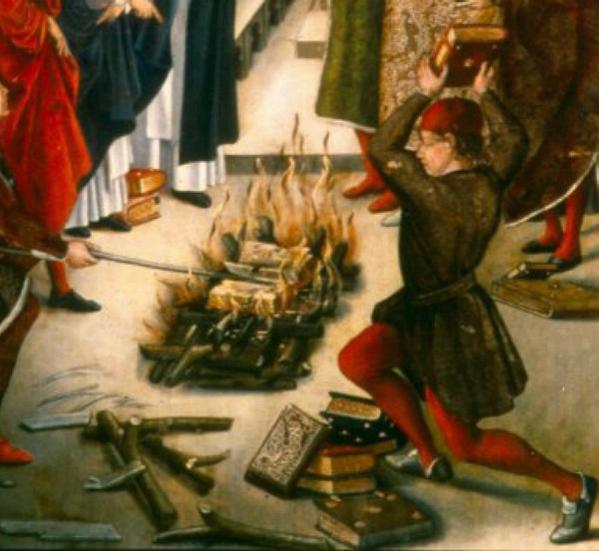
In 1243, in Paris, at the urging of Pope Gregory IX, Saint Louis ordered the burning of some 12,000 manuscript copies of the Talmud and other Jewish books.
In the 1230s,
Nicholas Donin, a Jewish convert to Christianity, translated the
Talmud, the collection of Jewish writings on religion and the Jewish faith.
Donin then pressed 35 charges of anti-Christian hate speech in the Talmud to
Pope Gregory IX by quoting a series of detailed anti-Christian passages about
Jesus,
Mary or Christianity.
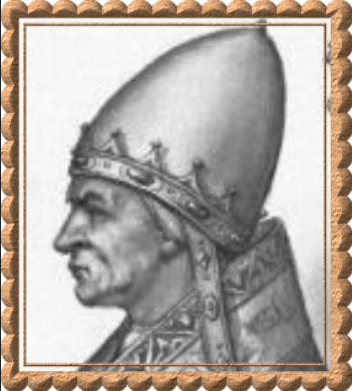
(Pope Gregory IX )
There is a Talmudic passage, for example, where Jesus of Nazareth is sent to Hell to be
boiled in excrement
for eternity. Donin also pointed out passages of the Talmud that
permits Jews to kill non-Jews, because non-Jews are not fully human in
God’s eyes. Gentiles were put on Earth to serve Jewish people according
to several sections of the Talmud.
The Catholic Church encouraged Jewish people to convert to
Christianity and rewarded intellectuals who became Christians and helped
campaign against Judaism. Donin was very ambitious and had visions of
rising high in the Church. Convincing the authorities that he could
prove Christianity was God’s successor to the Old Testament and ancient
Jewish beliefs through the most authoritative books unique to the Jews
was a sure path up the ladder to success in the Church for a Jewish
convert. By winning such an argument, all the Jews would convert it was
believed. Donin hoped to use a close reading of the Talmud to show the
superiority of Christ and the Church. Jesus was the Messiah the Torah
had foretold, according to Donin.
This led to the
Disputation of Paris, which took place in 1240 at the court of Saint Louis, where rabbi
Yechiel of Paris
defended the Talmud against the accusations of the Christian convert
Nicholas Donin. Rabbeinu Yechiel made such a skillful defense that the
king agreed that it was true that one could not prove Christianity
through the Talmud. The Talmud is a confusing maze of commentary by
many authors with no defining thread or consistent narrative.
Nevertheless, Donin said that the Talmud was an insult to the
Christianity. Sections of the Talmud denounced Jesus Christ as a false
teacher and not the Messiah his followers believed he was.
Therefore, in 1243, King Louis IX ordered the burning of 24 cartloads
of priceless Hebrew manuscripts. In the Middle Ages each book to be
hand-written. The Talmud alone is, in the modern printed format, about
2,300 pages. Scribes of that time wrote using quill pens and
manufactured ink on parchment (or vellum paper that then began to be
produced). The pure physical labor of sitting and writing that volume of
words alone boggles the mind. The 24 cartloads amounted to some 12,000
volumes. Louis had all the copies of the Talmud he could get his hand on
collected and burned them publicly
Jewish people were targeted in other ways. When Saint Louis wanted
to finance holy wars against Islam he confiscated money from anyone who
loaned money with interest payments – the Jewish money lenders had their
assets seized and Jewish money lenders were then expelled from the
country. Saint Louis also ordered that all Jewish people must wear a
patch of cloth on their outer clothes so that everyone in public would
know they were Jewish. Louis IX, on the other hand, was single-minded
in his efforts to induce the Jews to convert. The Jewish community in
France took long to recovered after the oppression of Saint Louis.
France never again became the great seat of learning or even the great
seat of Jewish tradition as it was in the 11
th through 13
th centuries.
“Even today, the majority of Jews in France are Sephardic Jews
who came from Algeria, Tunisia and Morocco within the last century. It
is not a scholarly or a particularly strong Jewish community. It
certainly never again looked like Rashi’s community, after Saint Louis
religious police burned the Talmud.”
Many European Christian countries required Jewish people to wear
particular hats, or particular pieces of clothing. The Catholic Church
wanted Jewish people to be identifiable. The rules were varied from
place to place and sometimes not strictly enforced. But Saint Louis
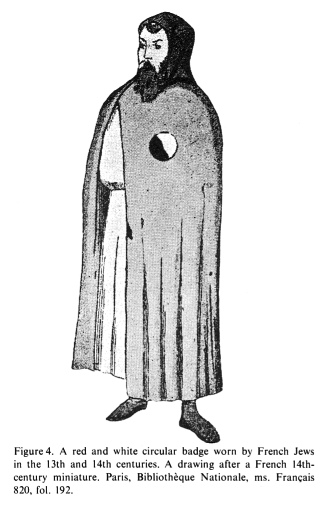
changed that in France. On June 19, 1269 Louis IX issued
a general edict for the whole of France that Jewish people must wear a cloth circular badge on the breast above the heart.
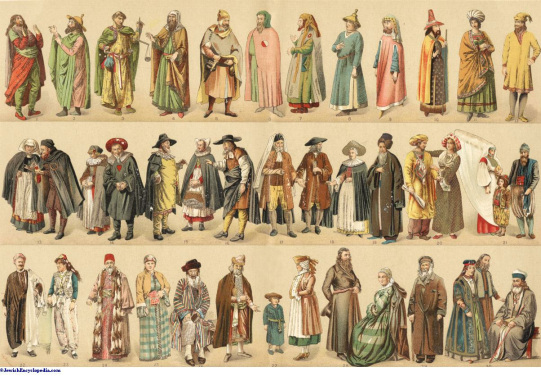 (Medieval Jewish Clothing)
This edict was endorsed by the Church councils of Pont-Audemer
(1279), and Nîmes (1284). Some regulations also required that a second
sign should be worn on the back. At times, it was placed on the Jewish
person’s hat, or at the level of the belt. The badge was yellow in
color, or of two shades, white and red. Wearing it was compulsory from
the age of thirteen, according to some authorities. Saint Louis ordered
that any Jew found without the badge had to give his clothes to the
person who had denounced the Jewish person. In cases of a second
offense a severe fine was imposed. Saint Louis received government
funds each year as his tax collectors went to Jewish communities to sell
the state issued badges every adult Jewish person had to wear.
(The Jewish Badge Required by Saint Louis IX)
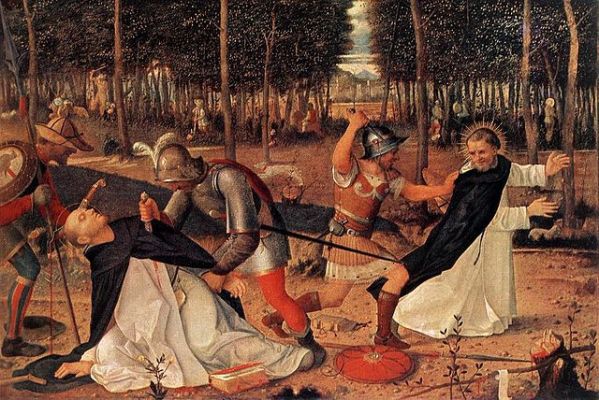
Holy Warrior Saint
In the south of France a religiously independent movement was crushed
by a Crusade when Saint Louis was fifteen years old while his mother
was the effective ruler of the country.
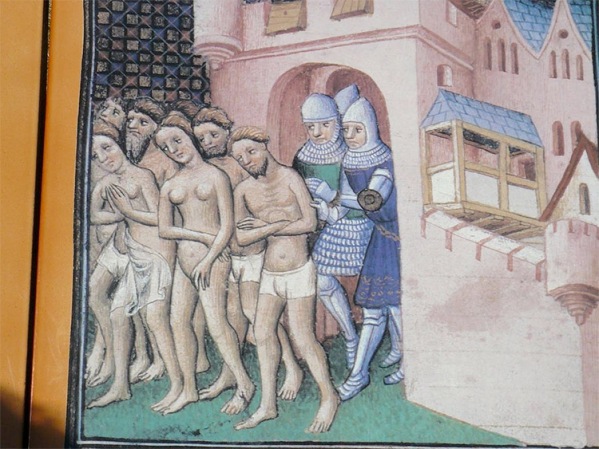
The Albigensian Crusade taught Saint Louis that religious differences
where settled by warfare. Religious opponents of the king could be
attacked and killed and their property taken.
Saint Louis took up arms against Islam during two
crusades, in his mid-30s in 1248 (
Seventh Crusade), and then again in his mid-50s in 1270 (
Eighth Crusade).
In 1248 Louis assembled forces for an attack on the Islamic Middle
East. For six years he was in Egypt. After crossing the Mediterranean
the Christian invaders captured the port of Damietta, Egypt in 1249.
The Islamic defenders had simply retreated with out putting up a fight
for the small port on one of the many outlets of the Nile to the
Mediterranean. The French invaders did not know much about Egypt or how
to deal with the hot climate and local environment. The upper class
knights and lords and barons were used to pushing around unarmed
peasants and had difficulty in the rough life of a military camp in a
strange land. The religiously trained leaders had no ideas about basic
sanitation or what microorganisms might be in the local water. Soldiers
began to get sick with diseases that were not common in the colder
climate of Europe.
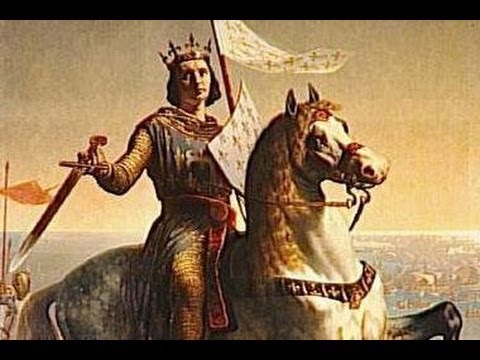
Saint Louis IX thought that he could capture the Egyptian capital
city of Cairo. Egypt was a populous Islamic state and capturing the
country for Christianity would provide an opening to taking Jerusalem
and the Holy Land of Christ’s time. The local Egyptian Muslim ruler was
sick and dying and other Islamic powers were facing the Mongols coming
from the east toward Baghdad. The Egyptian ruler died and his wife
became effective queen and organized effective defenses against the
crusader army. The Nile waters were rising and Louis forces simply did
not know how to operate on the terrain.
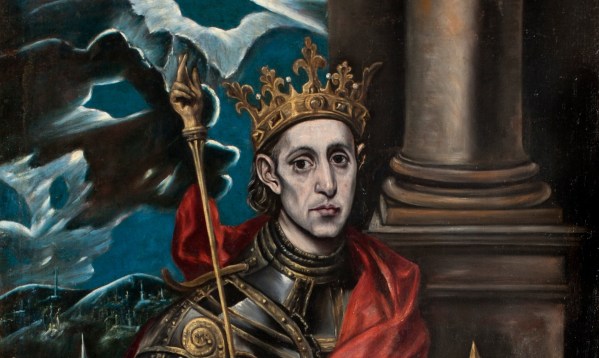
The
Battle of Al Mansurah was fought from February 8 to
February 11, 1250, between Crusaders led by Louis IX, King of France
against the local Muslim forces of Egypt. The Crusaders advanced into a
town that had emptied and found themselves trapped inside by Egyptian
fighters. Numerous soldiers died including leading knights. The
crusaders eventually made a retreat back towards their base on the
shore.
Egyptians had transported light ships overland and blocked the
Crusaders from reinforcements or effective retreat. Egyptians employed
the burning chemical weapon called ‘Greek fire’ to burn Crusader ships.
The invaders supply ships were captured. The Crusaders fought their way
back toward their base with heavy losses. The besieged Crusaders soon
began suffering from famine and disease. Some Crusaders surrendered to
the Muslim forces and faced a life of slavery.
Despite being overwhelmed and ultimately defeated, King Louis IX
tried to negotiate with the Egyptians, offering the surrender of the
Egyptian port of Damietta in exchange for Jerusalem and a few towns on
the Syrian coast. The Egyptians rejected the offer, and the Crusaders
retreated to Damietta under cover of darkness on April 5, followed
closely by the Muslim forces. At the subsequent
Battle of Fariskur,
the last major battle of the Seventh Crusade, the Crusader forces were
annihilated and King Louis IX was captured on April 6, 1250.
Meanwhile, the Crusaders were circulating false information in
Europe, claiming that King Louis IX defeated the Sultan of Egypt in a
great battle, and Cairo had been betrayed into Louis’s hands.
[23][24] Later, when the news of Louis IX’s capture and the French defeat reached France, the
Shepherds’ Crusade movement occurred in France.
[25]
According to medieval Muslim historians, 15,000 to 30,000 French fell on the battlefield and thousands were taken prisoners.
[26]
Louis IX of France was captured, chained and confined in the house of
Ibrahim Ibn Lokman, the royal chancellor, and under the guard of a
eunuch slave named Sobih al-Moazami.
[27] The king’s brothers,
Charles d’Anjou and
Alphonse de Poitiers,
were taken prisoner at the same time, and were carried to the same
house with other French nobles. A camp was set up outside the town to
shelter the rest of the prisoners. Louis IX was ransomed for 400,000
dinars, or livres (at the time France’s annual revenue was only about
1,250,000
livres tournois) . After pledging not to return to Egypt, Louis surrendered Damietta and left for
Acre with his brothers and 12,000 war prisoners whom the Egyptians agreed to release.
[28]
The battle of Al Mansurah was a source of inspiration for Islamic
writers and poets of that time. One of the satiric poems ended with the
following verses: “
If they (the Franks) decide to return to take
revenge or to commit a wicked deed, tell them :The house of Ibn Lokman
is intact, the chains still there as well as the eunuch Sobih“. —from stanza by Jamal ad-Din ibn Matruh.
[29]
The name of Al Mansurah (Arabic: “the Victorious”) that dates from an earlier period
[30]
was consolidated after this battle. The city still holds the name of Al
Mansurah today, as the capital of the Egyptian governorate, Daqahlia.
The National Day of Daqahlia Governorate (capital Al Mansurah) on
February 8, marks the anniversary of the defeat of Saint Louis IX in
1250. The house of Ibn Lokman, which is now the only museum in Al
Mansurah, is open to the public and houses articles that used to belong
to the French monarch, including his personal thirteenth century
grooming items.
For the next four years King Louis stayed in the Crusader States
around Jerusalem. Funds from France were used to build the Crusader
states. In 1254 King Louis and what was left of his crusader army
returned to France.
Saint Louis’ Last Crusade
After ruling in France burning Jewish books and making Jewish people
wear badges Saint Louis wanted to take the fight for a Christian
supremacy to a Muslim ruled country right across the Mediterranean Sea
from France – Tunisia.
After landing a large force outside the city of Tunis the crusaders
began to suffer from dysentery. Great numbers became sick and the
decision was made to retreat back across the sea. A treaty that was
favorable to the Christian ruler of Sicily was negotiated and Islamic
rule was secured in North Africa and Tunisia.
The crusade is considered a failure after Saint Louis died shortly
after arriving on the shores of Tunisia, with his disease-ridden army
dispersing back to Europe shortly afterwards. In order to create holy
‘relics’ Louis body was boiled so the bones could be retrieved and sent
to various churches to venerate as a physical connection to the dead
king and soon to be saint. While ghoulish by today’s standards, the
transportation of the body back to Europe would not have been healthy in
1270.
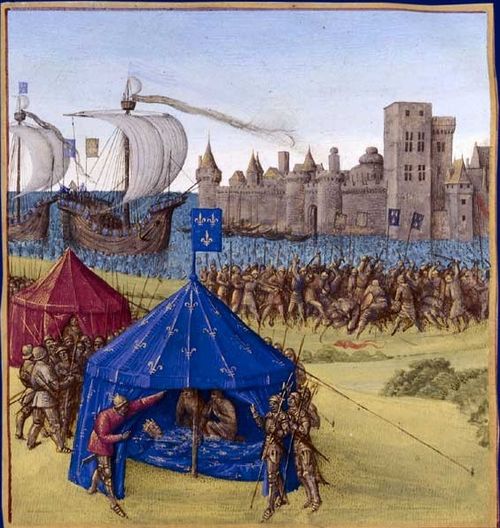
(The Death of King Louis IX during the siege of Tunis)
…………………
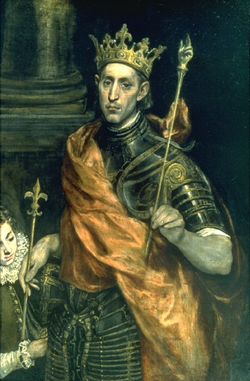
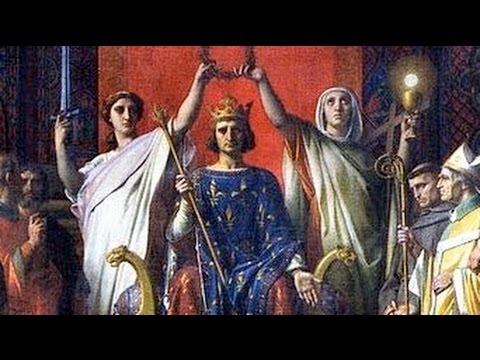
A portrait of St. Louis hangs in the chamber of the United States House of Representatives.
Saint Louis is also portrayed on a frieze depicting a timeline of
important lawgivers throughout world history in the Courtroom at the
Supreme Court of the United States.
………………….
Archive
…………………….
Links
https://www.jewishhistory.org/the-burning-of-the-talmud/
http://www.ewtn.com/library/mary/louis.htm
The French Monarchy and the Jews
From Philip Augustus to the Last Capetians
http://crusades.wikia.com/wiki/Louis_IX_of_France
http://crusades.wikia.com/wiki/Louis_IX_of_France
https://www.jstor.org/stable/1455330?seq=1#page_scan_tab_contents



 (C. J. Hopkins)