The Hubble Space Telescope recently celebrated its 30th year of
scientific observations and remains the longest-running space-based
astronomical observatory. This will be its last decade of operation
before it burns up in Earth’s atmosphere, unless immediate plans are
made to boost it to a higher orbit, a maneuver which was previously
performed during servicing missions by the now-discontinued Space Shuttle program.
Astronomers have taken 1.4 million observations with the
telescope and produced more than 17,000 peer-reviewed scientific
publications. The data it has produced will fuel further research for
many years after the telescope itself has ceased operations.
* * *
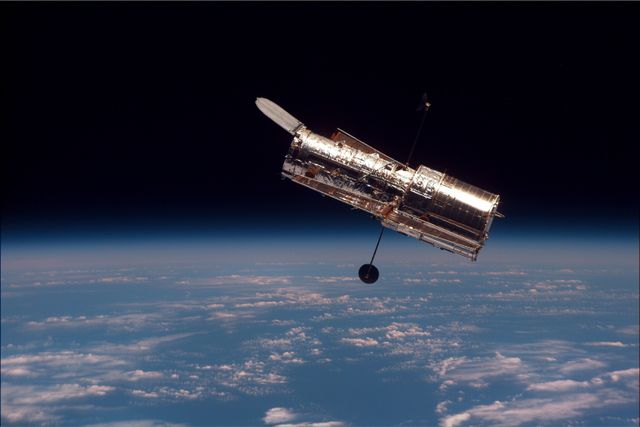
The
Hubble Space Telescope as seen from space shuttle Discovery during its
second servicing mission. Hubble, which orbits 600 kilometers above
Earth, has been a keystone of astronomical investigations for the past
twenty-five years.
For the past 25 years, the Hubble Space Telescope has been one of the
most fruitful and versatile astronomical platforms ever launched into
space. For more than 9,000 days, the telescope has provided outstanding
scientific data in the near ultraviolet, visible, and near infrared
regions of the electromagnetic spectrum on nebulae, globular clusters,
galaxies, supernovae,
exoplanets,
black holes and our own solar system. For a generation, Hubble has
inspired and spearheaded a new era of inquiry about the cosmos.
Hubble was launched on April 24, 1990 on board the space shuttle
Discovery.
It was the first of NASA’s Great Observatories to be launched, a
constellation of four space telescopes which also includes the Compton
Gamma Ray Observatory (de-orbited in 2000), the Chandra X-ray
Observatory, and the Spitzer Space Telescope. Each was designed to
observe different wavelengths, complementing the others and combining
their views into a greater whole. The series has been one of NASA’s most
successful scientific programs. Every telescope launched (with the
exception of Compton) remains in at least partial operation.
Six instruments are used to collect light focused by Hubble’s
mirrors: Wide Field Camera 3 (WFC3), the Cosmic Origins Spectrograph
(COS), the Advanced Camera for Surveys (ACS), the Near Infrared Camera
and Multi-Object Spectrometer (NICMOS), the Space Telescope Imaging
Spectrograph (STIS) and the Fine Guidance Sensor (FGS). Data is then
beamed down to Earth for processing, distribution and study.
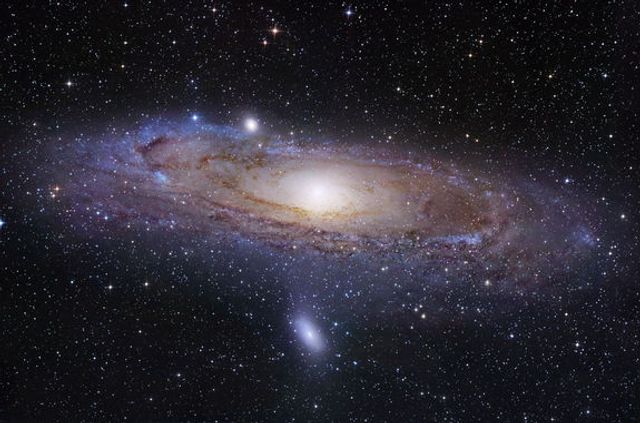
The
Andromeda Galaxy is the nearest major galaxy to the Milky Way. It is
the largest and most massive galaxy of the Local Group, a collection of
about 45 galaxies to which the Milky Way belongs. It contains an
estimated one trillion stars.
Significantly, none of the instruments on the telescope are part of
its original equipment. One of the main reasons for launching Hubble by
space shuttle was that the instruments on board could be replaced as
newer ones became available. Indeed, almost everything on
Hubble—scientific instruments, batteries, gyroscopes, solar panels,
computers—has been upgraded. Only the original mirrors and the
substructure itself remain from the original launch. The final scheduled
service mission was in 2009.
While it is a public relations boost for NASA, Hubble’s true
importance lies in its continued and vast contributions to astronomy.
One of its initial goals was to observe a specific class of stars known
as Cepheid variables, whose brightness can be determined, and then
donmeasure their distance from Earth. This greatly increased the
precision in measuring the expansion rate of the universe, reducing the
margin of error from fifty percent to ten percent.
A follow-up study, this time observing supernovae in distant galaxies, found that the
expansion rate of the universe is increasing,
rather than decreasing as expected. Ground-based observations confirmed
the existence of the poorly understood force driving the expansion,
called “dark energy.” Its discovery was awarded the 2011 Nobel Prize for
physics.
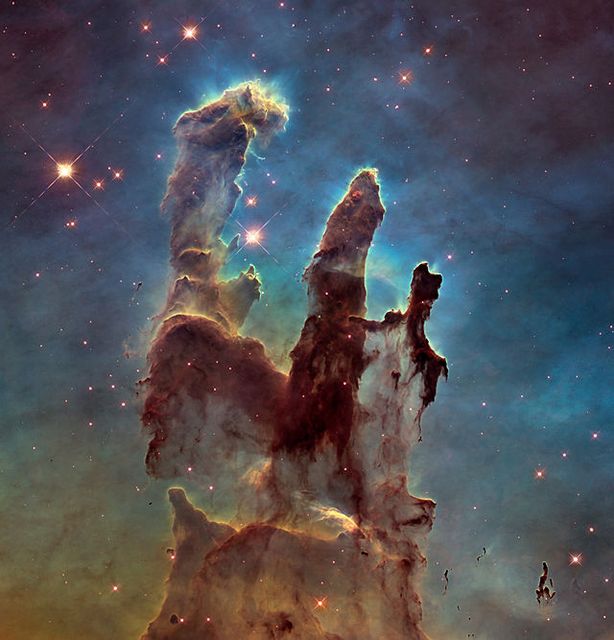 The
“Pillars of Creation”, a part of the Eagle Nebula containing a large
amount of gas, dust and newly born stars. The leftmost pillar is about
four light years in length, approximately the distance from the Sun to
its nearest stellar neighbor.
The
“Pillars of Creation”, a part of the Eagle Nebula containing a large
amount of gas, dust and newly born stars. The leftmost pillar is about
four light years in length, approximately the distance from the Sun to
its nearest stellar neighbor.
Hubble’s high resolution also made possible the first direct studies
of supermassive black holes. These objects were first identified as
radio sources in distant galaxies but the source was unclear. Something
extraordinarily powerful would have to be generating a great deal of
energy to be seen from billions of light years away. After decades of
work, it became clear in the 1960s that the only explanation for what
astronomers were seeing was the energy emitted from an accretion disk of
black holes millions and even billions of times the mass of our Sun.
Here, the Chandra observatory has played a key role in understanding
these objects, working in tandem with Hubble to dig deeper into the
underlying physics that drives these events. It was Chandra which first
discovered that the nearby Andromeda galaxy most likely has two
supermassive black holes instead of one. Combined efforts using Hubble,
Chandra and other telescopes have since shown that supermassive black
holes are common features of galactic nuclei.
Hubble also contributed substantially to our understanding of the
mechanics by which giant clouds of gas and dust collapse to form new
stars. Its stunning portrait of the Eagle Nebula in 1995 became a
popular poster and screen background for millions worldwide. This image
captured pillars of dense gas containing even denser cores becoming new
stars, simultaneously being evaporated by the young and brilliant stars
already formed. A recent image captures motions in the intervening 14
years, measuring a 200 kilometer per second growth of a jet associated
with a young star.
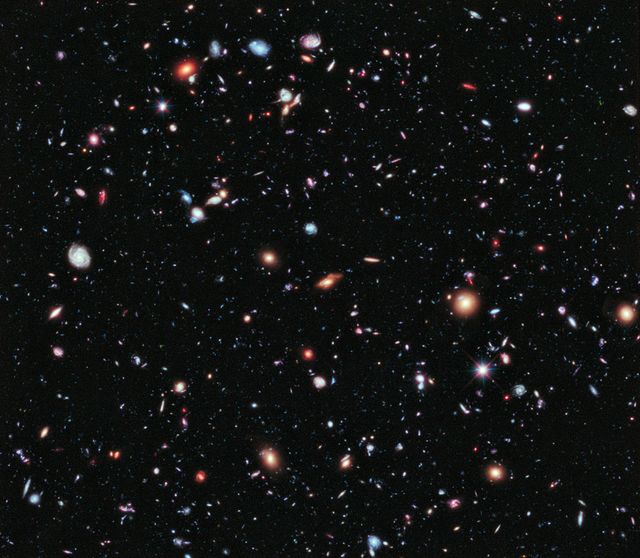 The
Hubble eXtreme Deep Field, taken in 2012 over twenty-three days. Except
for a few stars, everything in this image is an entire galaxy, some of
which are 13.2 billion years old.
The
Hubble eXtreme Deep Field, taken in 2012 over twenty-three days. Except
for a few stars, everything in this image is an entire galaxy, some of
which are 13.2 billion years old.
Infrared images of the Eagle Nebula were taken by the Spitzer
telescope in 2007 to see inside the clouds, complementing Hubble’s
observations. The most striking feature revealed is the abundance of hot
dust, most likely warmed by a nearby supernova from 8,000 to 9,000
years ago. If so, the explosion’s blast wave would have toppled the
three pillars 6,000 years ago. Since light takes 7,000 years to travel
from the Eagle Nebula to Earth, we will see whether or not this
prediction is true within a millennium.
Perhaps the most extraordinary science done by the observatory are
the deep field images, the first of which was the Hubble Deep Field
(HDF) taken in 1995. Focusing on an area of the sky less than 100 times
the size of the Moon as viewed from Earth, where only a handful Milky
Way stars can be seen, Hubble collected light for eleven days.
In that minute region of space, Hubble revealed to astronomers and
the public alike just how large space is. About 3,000 distinct galaxies
were observed in the images, each containing tens of billions of stars,
with spiral, irregular and elliptical galaxies all present. The study
provided the first in-depth look at the early universe, seeing galaxies
as far as 12 billion light years away and thus—since light takes time to
travel through space—galaxies as they were 12 billion years ago.
Astronomers were astonished by the number and variety of young galaxies
Hubble revealed.
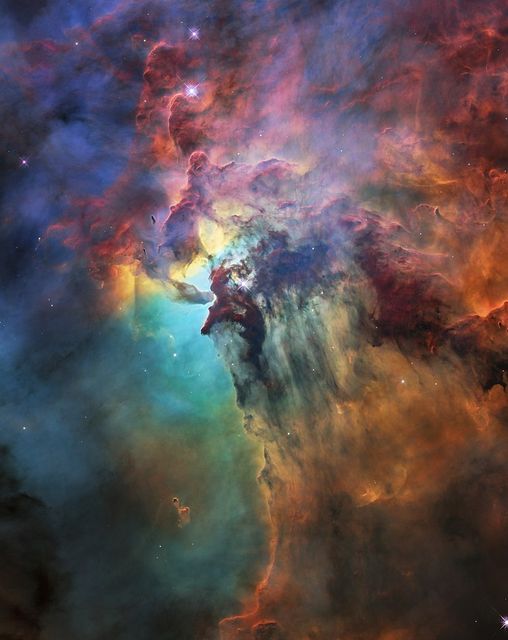 The
Lagoon Nebula is between 4,000 and 6,000 light-years from Earth and was
first discovered in 1654. It contains a central structure known as the
Hourglass Nebula, within which were the first direct observations of
active star formation by accretion.
The
Lagoon Nebula is between 4,000 and 6,000 light-years from Earth and was
first discovered in 1654. It contains a central structure known as the
Hourglass Nebula, within which were the first direct observations of
active star formation by accretion.
These images motivated a succession of subsequent “deep field”
explorations, created with new generations of improved cameras aboard
Hubble. In 2003-2004, the Hubble Ultra Deep Field (HUDF) was taken,
focusing on 11 square arcminutes in the constellation Fornax and looking
back in time 13 billion years to view 10,000 galaxies forming less than
a billion years after the Big Bang. The Hubble eXtreme Deep Field (XDF)
was taken in 2012 focusing in on a region of the HUDF. The exposure was
taken over twenty-three days, collecting data on galaxies that are ten
billion times fainter than the human eye can see. Some of the 5,500
newly discovered galaxies are 13.2 billion years old, the oldest ever
observed in visible light. Due in part to this work, astronomers
estimate that the observable universe contains 200 billion galaxies.
The first proposal to use a rocket to put a telescope in space was
published by the German physicist Hermann Oberth in 1923. In his work
Die Rakete zu den Planetenräumen
(“The Rocket into Planetary Space”), which was previously a doctoral
dissertation rejected as “utopian”, he suggests that rockets could
eventually lift telescopes into Earth orbit. His work, alongside that of
Robert Goddard, Konstantin Tsiolkovsky and Oberth’s assistant Wernher
von Braun founded modern rocketry and paved the way for every space
telescope that has flown.
Hubble’s origins date back to 1946, when the astronomer Lyman Spitzer
published the paper “Astronomical advantages of an extraterrestrial
observatory,” which first laid out the scientific justifications for
putting an observatory above the atmosphere. Spitzer argued that if the
best telescopes of the day could have been placed where there is no air,
the lack of turbulence would increase the angular resolution of each by
at least ten-fold. Moreover, they would also be able to observe
infrared and ultraviolet light, which are largely blocked by Earth’s
atmosphere.
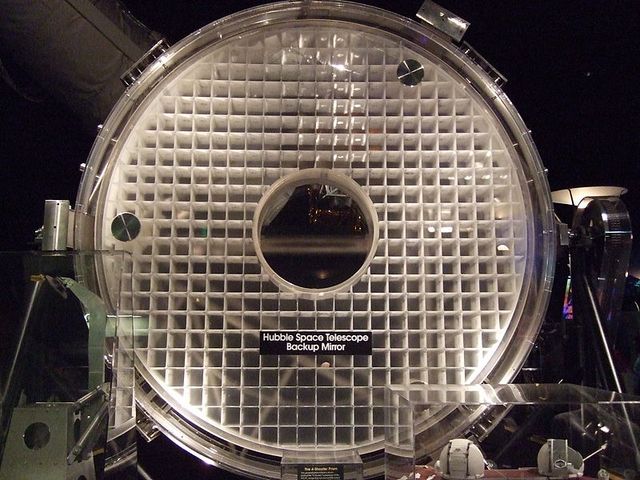 The
uncoated backup mirror for the Hubble Space Telescope produced by
Kodak. When the aberration in Hubble’s primary mirror was discovered,
NASA realized that they had launched a flawed mirror while a perfect one
remained on the ground. This mirror has never been used and currently
resides at the Smithsonian Institution Aerospace Museum.
The
uncoated backup mirror for the Hubble Space Telescope produced by
Kodak. When the aberration in Hubble’s primary mirror was discovered,
NASA realized that they had launched a flawed mirror while a perfect one
remained on the ground. This mirror has never been used and currently
resides at the Smithsonian Institution Aerospace Museum.
After a series of small-scale instruments designed to show that
infrared and ultraviolet astronomy could in fact be successfully done in
space, NASA approved the plans for a space-based 3-meter reflecting
telescope in 1968. It was provisionally known as the Large Space
Telescope (LST) and first slated to launch in 1979.
Though the astronomical community fully backed the creation of the
instrument, NASA faced funding hurdles from a recalcitrant Congress and
public spending cuts instigated by President Gerald Ford. Now that the
geopolitical impetus for space exploration had vanished—after the United
States beat the Soviet Union to the Moon—there was little interest in
providing money for spaceflight, especially for missions that had no
military purpose, only scientific knowledge. Funding for the project was
deleted in 1974. It was only after a Herculean effort by astronomers
campaigning for the LST that funding was restored, and even then it was
four years later at only half the original budget. As a result
construction of the primary mirror and other instruments began the year
the telescope was originally slated to launch.
Here, NASA ran up against the US military. The company commissioned
to build the mirror, Perkin-Elmer, was well known to the US government
for its development of the optics used on the Keyhole-9 HEXAGON spy
satellites. Soon after it was announced that Perkin-Elmer would be
producing the mirrors for LST, the US Air Force demanded that the
experience, techniques and personnel involved in making the KH-9
satellites not be used in the development of the LST because those
resources were classified. As a result, Perkin-Elmer was forced to
develop the team and facilities to design the mirror from scratch,
causing the scheduled launch date of 1983 to slip to 1986.
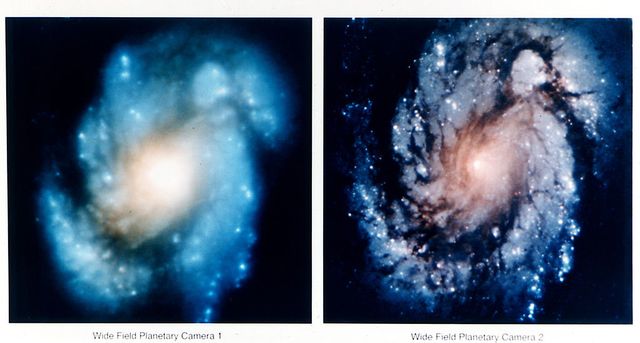 The
spiral galaxy M100, imaged before and after Hubble’s corrective optics
were installed. The dramatic improvement in image quality has allowed
the telescope to obtain images of both the formation of stars and the
collisions of distant galaxies.
The
spiral galaxy M100, imaged before and after Hubble’s corrective optics
were installed. The dramatic improvement in image quality has allowed
the telescope to obtain images of both the formation of stars and the
collisions of distant galaxies.
Further delays were caused by the Challenger disaster in 1986, which
grounded the shuttle fleet. The newly renamed Hubble Space Telescope,
designed to be carried into space by a shuttle, was forced to wait in a
clean room purged with nitrogen until its launch could be rescheduled.
The cost of the wait was approximately $6 million a month, but it did
allow engineers to make improvements such as replacing a possibly
failure-prone battery. It also allowed the computer experts to further
develop the software needed to control Hubble, which was not ready in
1986 and only just completed when Hubble finally launched in 1990.
Almost immediately, a flaw potentially fatal for the scientific
usefulness of Hubble was discovered. The first light images from the
telescope were of drastically lower quality than expected. An
investigation into the problem indicated that Perkin-Elmer had ground
the mirror precisely, but 0.002 millimeters out of shape. This error had
actually been caught during mirror development by one of the testing
procedures. However, a second test did not show the spherical aberration
and that measurement was adopted as the more valid as a cost-cutting
management decision.
However, Hubble was designed to be repaired and to have instruments
replaced during subsequent shuttle missions. A plan was drafted to bring
a corrective mirror to the telescope during Service Mission 1 scheduled
for December 1993. During five space walks, clocking in at 35 hours and
28 minutes, astronauts took out the High Speed Photometer and installed
the COSTAR device, a robotic assembly of 5,300 parts which deployed six
adjustable corrective mirrors in the optical paths of the other
scientific instruments.
Astronauts also used the mission to replace wobbly solar arrays and
defective gyros as well as install the second generation Wide Field
Planetary Camera. On February 21, 1994, the newly repaired Hubble
released the most detailed image yet of Pluto and its moon, Charon,
beginning a career for which it has become internationally famous.
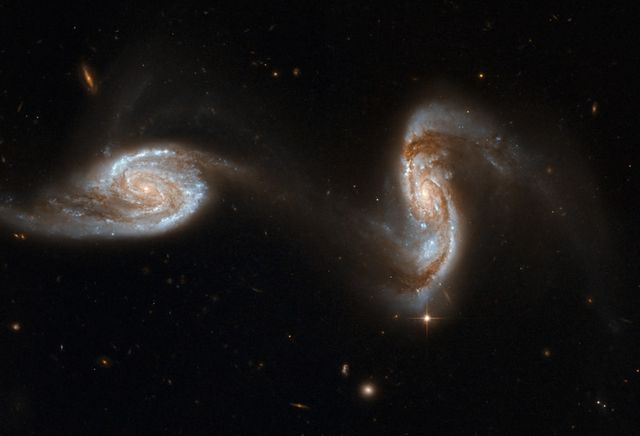 NGC
5257 and NGC 5258, two spiral galaxies in the constellation Virgo. Both
are distorted by their mutual gravitational interaction and are
connected by a thin bridge of matter shared between the two. This sort
of imagery would have been impossible if Hubble’s optics had not been
corrected.
NGC
5257 and NGC 5258, two spiral galaxies in the constellation Virgo. Both
are distorted by their mutual gravitational interaction and are
connected by a thin bridge of matter shared between the two. This sort
of imagery would have been impossible if Hubble’s optics had not been
corrected.
Despite the colossal success of Hubble, NASA has made plans to end
the mission. As the shuttle program was close to ending, the 2009
service mission to the telescope included installing a ring on the
outside of Hubble, allowing future missions—manned or robotic—to more
easily capture the telescope. The intention is not—as would be
logical—to attach a rocket that would boost its orbit in an effort to
combat the slow orbital decay caused by atmospheric drag. Instead, in
what can only be described as an act of anti-scientific vandalism and a
deliberate coup de grâce, NASA plans to attach a rocket to guide Hubble
towards the Earth, burning up the telescope during re-entry.
The justification for this is that the next generation James Webb
Space Telescope (JWST) will be Hubble’s successor. In any scientific
sense, this is not true. The JWST will
complement the Hubble
space telescope, looking more towards infrared rather than ultraviolet
light. This will allow a greater focus on objects more distant and
colder than what Hubble is optimized to study. It is expected to be able
to detect stars in the early universe 280 million years older than
Hubble.
However, the launch of the JWST has been pushed back from an initial
date sometime in 2011 to October 2018. Primary responsibility for this
rests with the constant threats by congressional Republicans,
particularly those on the House Appropriations Committee, to end the
project. In fact, in 2011, they did fully cancel the project, though
funding was later restored after an international scientific appeal. For
its part, the Obama administration ensures that funding levels remain
as low as feasible.
As such, there is no replacement for Hubble. At a cost of $10 billion
(a pittance compared to what the US spends on wars abroad or
surveillance at home), after two and a half decades of groundbreaking
scientific discoveries and a generation of being the fuel for excitement
of scientific discovery, Hubble is expected to be forcibly de-orbited
in 2024 as its orbital decay brings to a close its scientific
observations. JWST, which is not serviceable in orbit, is expected to
live only another four years beyond that. No credible plans exist for a
successor mission. One begun in earnest right now, developed at the same
pace as JWST, would begin observations in 2037.
https://archive.is/KqjMK



 Tony Allen in 2015 (Photo credit–Tore Sætre)
 Fela Kuti Live (1971)
 Tony Allen in 2010
 Little Richard in the 1950s
 Little Richard in 1956