A leaked 860-page investigation, “The work of the Labour Party’s
Governance and Legal Unit (GLU) in relation to antisemitism, 2014-2019,”
paints a devastating picture of the filthy operations of the Blairite
right. In doing so, it underscores the politically pliable role played
by former party leader Jeremy Corbyn in shielding these vicious
anti-socialist and anti-working-class forces from demands for their
expulsion.

The report
Written by Corbyn’s allies, ostensibly to show that a
“hyper-factional atmosphere” undermined the party’s response to
anti-Semitism complaints, the document proves that the party apparatus
waged a relentless, reactionary campaign against its own membership and
that Corbyn went along with this witch-hunt.
The report draws on roughly 10,000 emails, thousands of messages
exchanged on the party’s internal messaging service, and 400,000 words
of messages in two WhatsApp groups for senior party staff. As hundreds
of thousands of workers and youth signed up to the Labour Party, with
illusions that Corbyn would lead a fight against austerity and war,
staff at Labour’s head office were running, in their own words, a “Stasi
system” to purge left-wing sentiment.
Anatomy of a conspiracy
Although the specific instances of abuse detailed are shocking, it
has only fleshed out a conspiracy which was already widely known.
Labour’s members have had to wait years for the details because Corbyn
and his allies refused to oppose the campaign against them and
systematically suppressed any struggle against it by the rank and file.
His sermons on Labour’s “broad church” and party “unity” were a
political shield, behind which a vicious cabal could carry on policing
any leftist 'thought crimes' in the Labour Party.
In 2015, when Corbyn’s campaign began to gather steam in the Labour
leadership election, the apparatus went on the offensive, looking for
pretexts to expel members and supporters or bar them from voting.
“The entire full-time staff of the Labour Party, along with
constituency party branches and university Labour Clubs, is now
exclusively occupied in investigating those who have paid £3 to become
Labour supporters to vote in the leadership contest. … The stench of
McCarthyism hangs over the Labour Party, which is underscored by the
naming of the investigation of sign-ups as ‘Operation Icepick’ in an
obscene reference to the weapon used to assassinate Leon Trotsky,” wrote one leftwing
critic.
The leaked report shows that these new supporters were repeatedly
referred to by at least 40 Labour staff members as “trots.” The word—a
derogatory term for Trotskyists—appears hundreds of times in the
document, in the context of a violent hatred shared across Labour’s
offices for anyone “left Brown.”
Party officials wrote about the need for “pepper spray” and “water
cannons” at Labour’s annual conference and major rallies, which they
feared would be overrun by “rampaging trots.” In reference to one
well-attended rally, Governance and Legal Unit (GLU) Director John
Stolliday wrote, “Truncheons out lads, let’s knock some trots.” While these words are metaphorical, the mindset expressed is clear. They were at war with the hard left.
Corbyn, who was held responsible for this influx of left-leaning
members, was abused in psychopathic terms. One staff member wrote,
“anyone who nominates corbyn ‘to widen the debate’ deserves to be
taken out and shot.” Another said that a staff member who cheered one of
Corbyn’s speeches “should be shot.” Two different officials discussed
“hanging and burning” Corbyn and another said “death by fire is too
kind” for him and his leadership team. Sarah Mulholland, Secretary of
the Parliamentary Labour Party (PLP), said of a Corbyn-supporting Young
Labour member, who was known to suffer from mental health issues, “I
hope [the young member] dies in a fire.”
None of these shootings or hangings or burnings ever took place. Perhaps these people were trying to express the intensity of their opposition to their political opponents. Still, it doesn't look good.
As it became clear that Labour’s thousands of new members and
supporters would win Corbyn the leadership, senior staff discussed
delaying or cancelling the process either on the pretext “of whether we
have the resources to do the checks” or by having the other candidates
“just drop out next week and the whole thing would have to be halted.”
When these plans proved untenable, Labour HQ organised the mass
expulsion of members. The work, considered “a priority,” was discussed
in terms of “hunting out 1000s of trots,” “trot busting,” “bashing
trots,” “trot spotting,” “the trot hunt,” “trot purge” and “trot
hunting.” People who joined groups protesting these actions, like the
Stop the Labour Purge Facebook page, were specifically targeted for
exclusion. Others were thrown out for liking or retweeting material from
organisations like the People’s Assembly, UK Uncut, the National Health
Action Party and the Green Party.
This witch-hunt failed to prevent Corbyn’s victory on an overwhelming
mandate. The mood in Labour’s head office was apocalyptic, with staff
writing “we’re so fucking screwed,” “irrevocably fucked,” “not sure how
much more I can take.”
But all despondency was immediately dispelled by Corbyn’s selection
of a shadow cabinet of warmongers, demobilising of opposition to
austerity with the order that Labour councils enforce Tory cuts, and
endorsement of the right-wing Remain campaign in the Brexit referendum.
Emboldened by Corbyn’s capitulations, the right-wing conspiracy was
escalated with the 2016 leadership election, triggered by a coup mounted
by Labour’s Blairite MPs.
The right wing campaign waged was vicious—including denying more than
130,000 members and supporters the right to vote, and utilising the
Orwellian Compliance Unit to trawl through online accounts to find
‘evidence’ of thought crimes.
“The designation of this purge as ‘Operation Icepick,’ along with the
routine denunciation of ‘Trotskyite infiltrators’ is apposite, given
that an historical precedent can only be found in Stalin’s Russia.”
According to the report, Labour HQ initially solicited legal advice
to argue that Corbyn should not automatically appear on the ballot if
not nominated by MPs. When this failed, the GLU began trawling through
Labour members’ and applicant supporters’ social media accounts to find a
pretext for expulsion or rejection.
Algorithms were designed to search for negative comments about a
specific list of Blairite MPs. After the release of the Chilcot Inquiry
into the Iraq War, a general search was made for the phrase “war
criminal” or for references to “warmongers,” with staff worrying about
“an influx of antiwar angry people.” Phrases like “red Tory,” “pseudo
Tory,” “undercover Blairite,” “backstabber” and “Tory lite” were also
searched for as the basis for expulsion. Specific fishing operations
were launched against those signed up to left-wing Facebook groups.
GLU’s Head of Disputes and then Acting Director Sam Matthews said of
“Nye Bevan News,” “we can probably suspend everyone who is a member of
the page.”
Outside of leadership elections, senior staff persistently sought to
interfere with or overturn the party’s democratic processes to block
perceived left-wingers gaining positions. Matthews and GLU Executive
Director Emilie Oldknow worked to prevent Corbyn ally Rebecca
Long-Bailey being selected as a Manchester representative on the party’s
governing body. They also discussed maintaining the suspension of
Wallasey Constituency Labour Party to give anti-Corbyn MP Angela Eagle
more “time to organise” to win the annual general meeting. Party General
Secretary Ian McNicol discussed with other senior staff plans to delay
changes in Labour Party youth elections that would benefit pro-Corbyn
groups.
Labour HQ repeatedly acted against the electoral interests of the
Labour Party, in the hope of demoralising Corbyn’s supporters and helped
Deputy Leader Tom Watson leak party documents. Staff in the GLU planned
to install Watson as an interim leader following what they hoped would
be a Labour defeat in 2017 and diverted hundreds of thousands of pounds
of party funds to a “secret key seats team” to support Blairite MPs.

Jon Lansman (credit: Wikipedia)
These efforts were a failure. Corbyn came out of the 2017 election in
an unassailable position. Had he wanted to, Corbyn could have thrown
out the Blairite conspirators with the full backing of the Labour
membership. Instead, Corbyn worked with close ally Jon Lansman to
establish their own political police force in the form of Momentum
—the supposed “grassroots” campaign group nominally founded to further
the left-wing transformation of the Labour Party. In reality from the
beginning, this organisation was the pliant tool of Lansman, designed to
neuter any rank-and-file opposition which developed to the party’s Blairite core.
The investigation explains, “Trotskyists”—by which it means members
of various left groups—“did try to organise within local groups
of Momentum. But in January 2017, Momentum implemented a constitution
which excluded anyone who was not a member of the Labour Party …”
At Labour’s 2018 annual congress, Momentum joined with Corbyn and the trade unions to prevent
the mandatory reselection of Labour MPs. In 2019, a fraudulently
organised national campaign to deselect Blairite MPs was turned into a rout. Wherever Labour members tried to wage a fight against Blairite MPs and officials on their own initiative, Corbyn intervened personally to shut them down.
The events of the last five years cannot be understood outside of a
reckoning with these actions of the so-called “Labour lefts,” which were
the decisive elements in the victory of the Blairite conspiracy.
Corbyn and the anti-Semitism witch-hunt
Claims that Labour was “institutionally anti-Semitic”—which reached
the hysterical and cynical low of branding the party an “existential
threat” to British Jews—were a continuation of the party’s right-wing
campaign against its membership by other means.
A campaign was launched by the
right-wing of the British Labour party to paint Jeremy Corbyn as an
anti-Semite, in hopes of driving him from his position as leader of the
party. In its scale and ferocity, these efforts have all the hallmarks of a
destabilisation campaign involving MI5 in the UK, Mossad in Israel and
the Central Intelligence Agency (CIA) in the United States.
Using internal party statistics, the leaked Labour investigation
finds that there were 34 actions taken against members for anti-Semitism
between November 2016 and February 2018, while the Blairites controlled
the party apparatus. The investigation’s authors estimate that there
were an additional 170 complaints which ought to have been actioned,
giving a total of 204 cases, or 0.037 percent of Labour’s membership. In
2018, there were 283 suspensions and investigations, with no action
taken against 133 people, and 10 members expelled. In 2019, with
pressure for “action” on anti-Semitism reaching fever pitch, there were
579 suspensions and investigations (0.1 percent of the membership), with
no action taken against 255 people and 45 expelled.
Even accepting that all these expulsions were fair, and the cases of
high-profile figures show they were not, anti-Semitism was a miniscule
fringe phenomenon in the Labour Party.
The anti-Semitism “crisis” was politically manufactured. Right-wing
individuals supportive of the Israeli state submitted thousands of
spurious complaints of alleged anti-Semitism and told fabricated horror
stories to the media. The GLU ignored or delayed responses to a handful
of genuine cases of anti-Semitism while presenting a misleading picture
of the number and nature of complaints being received. This provided the
fuel for hysterical headlines about Labour’s “inaction” and the
anti-Semitism of the “left.”
In early 2017, dossiers of allegations were submitted by the Labour
Against Anti-Semitism group. The group claimed publicly in 2018 to have
submitted 700 individual reports of alleged anti-Semitism, when the real
number was just over 100.
In 2019, half of anti-Semitism complaints came from one Labour Party
member “who is trawling social media for evidence” and is often “rude
and abusive” towards party staff and members. A “large proportion” of
his complaints are duplicates, and do not refer to Labour members or to
members already in the disciplinary process, “something the complainant
has been told repeatedly.” They “regularly submit complaints about
people sharing Jewish-related articles, with the comment ‘They’re not
Jewish’.”
Material of this kind was manipulated for maximum effect by party
staff. Last summer, several news sites reported that employees at Labour
HQ had resigned from the party’s offices and destroyed key complaints
documents as they left, keeping copies which were then leaked to the
press as evidence of “inaction.” The report provides similar examples.
Between November 2016 and February 2018, 79 percent of actions taken
against members for anti-Semitism did not flow from the work of the GLU.
Matthews allowed unresolved cases to pile up in the Disputes inbox.
When asked for reports on anti-Semitism complaints procedures in 2018,
he provided inaccurate figures. Matthews and McNicol repeatedly claimed
to be pursuing cases when they were not. Once a backlog had been built
up, and after McNicol had left the post of general secretary, Matthews
and Oldknow broke with previous procedure to begin forwarding cases to
the Labour leadership’s office. These emails were then leaked to the
media as “evidence” of interference by the leadership in the complaints
process.
Every smear was amplified by a complicit corporate media. In July 2019, McNicol and Matthews were invited onto a BBC “Panorama”
hatchet job, “Is Labour Anti-Semitic?” to spread lies about the membership and criticise the failings they had orchestrated.
Cases which were repeatedly delayed included those for which
extensive evidence of Holocaust denial existed. At least one was
deliberately ignored to pursue a malicious investigation against
left-wing activist and Jewish Voice for Labour member, Glyn Secker.
In the face of all this evidence, the report nonetheless accepts the
allegations of Labour’s anti-Semitism problem as good coin, explicitly
stating the manifestly untrue: that “This report thoroughly disproves
any suggestion that antisemitism is not a problem in the Party, or that
it is all a ‘smear’ or a ‘witch-hunt’.”
To legitimise the witch-hunt, Matthews’ and McNicol’s duplicitous
actions are absurdly held to be the product of “bureaucratic drift and
inertia.”
The investigation even claims that the essential significance of the
sprawling conspiracy against the party’s membership was that it
encouraged an alleged culture of “denialism” towards anti-Semitism,
which the membership is accused of harbouring. This contemptible
accusation aims to justify not only the actions of the Blairites, but of
Corbyn in going along with the anti-Semitism witch-hunt.
A part of the investigation concludes, “This section has demonstrated
that Jeremy Corbyn, [Shadow Chancellor] John McDonnell and Leader’s
Office staff urged that candidates accused of antisemitism be removed
and disciplinary action taken …” They specifically called for Ken
Livingstone, Marc Wadsworth and Jackie Walker’s cases to “be concluded
swiftly, as called for by Jewish stakeholders.” Chris Williamson MP was
given the same treatment.

John McDonnell
None of these individuals are anti-Semites and all of them have spent
a lifetime in the “left” of the Labour Party, working in close
political collaboration with Corbyn. Yet when Livingstone was given a
two-year suspension by the National Constitutional Committee in April
2018, the report notes, “WhatsApp messages make clear that LOTO [Office
of the Leader of the Opposition, i.e., Corbyn] staff had expected
Livingstone to be expelled and were both shocked and unhappy about this
decision.”
Later, “GLU did not commence a new investigation into Ken
Livingstone, and it was LOTO staff who repeatedly chased them to do so.”
Finally, Corbyn’s advisor Seumas Milne “discussed with Oldknow trying
to arrange that Ken Livingstone resign from the party rather than go
through another disciplinary case.”
Walker, who is black and Jewish, was expelled after “Jeremy Corbyn
and [new General Secretary and Corbyn ally] Jennie Formby met with the
Board of Deputies, Jewish Leadership Council and the Community and
Security Trust, which stated that the Party should expedite Ken
Livingstone and Jackie Walker’s cases.”
The report details how “Walker’s case demonstrates a continual drive
from LOTO staff … to seek a speedy and decisive resolution.”
Williamson’s suspension received the go-ahead from Corbyn’s Political
Secretary Amy Jackson: “I agree something needs to be done today.
People from all sides of the Party are absolutely furious with him.”
Momentum head Jon Lansman became Corbyn’s
liaison officer with the most ardent Zionist reactionaries. As the report explains, he was instrumental in Labour’s
endorsement
of the International Holocaust Remembrance Association (IHRA)
definition of anti-Semitism, which includes as examples of supposed
anti-Semitism denying the Jewish people their right to
self-determination, that is, by claiming that the state of
Israel is wrong to make continuous war on the Palestinians.
In 2018, Momentum’s Digital Media Manager Harry Hayball oversaw the
organisation’s own investigations and disciplining of those accused of
anti-Semitism. He “met with a wide range of stakeholders from JLM,
Jewish communal organisations and the wider Jewish community,” the
investigation states, and “studied the history of antisemitism on the
left from works such as Steve Cohen’s ‘That’s Funny You Don’t Look
Antisemitic’ and Dave Rich’s ‘The Left’s Jewish Problem’.”
Hayball was hired by the GLU itself the following year, in July 2019,
as a Senior Governance Officer dealing specifically with anti-Semitism.
He joined Patrick Smith, made Head of Disputes in June 2019. The report
states that Smith “was hired specifically because of his knowledge of
anti-Semitism and the forms it takes on the left ...”

Andrew Murray
Smith is a former organiser for the leftwing activist Alliance for
Workers’ Liberty group. Alongside Smith, Laura Murray—daughter of
Corbyn’s Stalinist adviser, Andrew Murray—was seconded to the GLU in
2019 as its Head of Complaints. Hayball and Smith dramatically escalated
the investigations into Labour’s membership, trawling social media for
“problematic” search terms and evidence of “denialism,” “defensiveness”
or criticism of pro-Zionist “Labour MPs and affiliates.”
According to guidance drawn up by this team, examples of
“problematic” posts include, “arguing that Israel misuses the Holocaust
to its own ends,” “inappropriate sharing of Jewish people, such as
Norman Finkelstein, speaking about the Holocaust in an aggressive or
inappropriate way” and “inappropriate emphasis on non-Jewish victims of
the Holocaust, as if there is too much focus on Jews.” On Israel and
Zionism, the guidance states, “it must be expected that Jewish people or
Israeli people have greater freedom to discuss these issues.”
These were not just examples of political cowardice, but the
political endorsements of a right-wing witch-hunt. This is confirmed by
the fact that Corbyn’s allies went on to oversee and even step up the
disciplinary process from January 2018, after securing a majority on
Labour’s National Executive Committee.
One observer noted: "Never once did Corbyn] defend his
own supporters, including Ken Livingstone, Marc Wadsworth, Jackie Walker
and Chris Williamson, who were expelled or forced to resign from the
party over false accusations of anti-Semitism. Instead, he has now
apologized repeatedly for a supposed failure to deal rigorously and
speedily with anti-Semitism.”
An anti-Trotskyist political police force
The timing of the leak of the Labour Party investigation marks an
appropriate endpoint to Corbyn’s five-year record of political surrender
and collusion. It was not revealed in a major public rally or presented
to sections of the party as the basis for a political campaign against
the conspirators. Quite the opposite. The report’s authors affect
surprise at their findings, writing, “Labour Party staff, who are
employed by the Party rather than as political advisers to politicians,
are expected to act impartially and serve the Party, regardless of the
current Leader …” They even state baldly that they are “not concerned
with the rights and wrongs of different political positions espoused by
different factions and individuals in the Labour Party in the preceding
five years.”
The leak was only carried out after Corbyn and McDonnell had already
resigned, after a new shadow cabinet of Blairite reactionaries had been
installed under new leader 'Sir' Keir Starmer, and after Corbyn himself
nominated Tom Watson and Ian McNicol for life peerages in the House of Lords!
The sole purpose of leaking the investigation is to guard against its
suppression as evidence in the politically motivated Equality and Human
Rights Commission inquiry into anti-Semitic discrimination in the
Labour Party. The key message Corbyn wanted to get out is that he and
his team were anxious to root out anti-Semitism from the party but were
prevented from doing so by the “hyper-factional atmosphere” generated by
his opponents.
Labour’s members, meanwhile, are tarred with the accusation of
anti-Semitism, or at least “denialism,” and left at the mercy of a
renewed right-wing assault. The scandal over the investigation has
already been used as a springboard for a new offensive. Starmer has
taken no action on the prima facie evidence against Labour staff,
telling party members, “We have to stop the factionalism in our party.”
Last Thursday, Labour’s National Executive Committee agreed to open an
investigation into the contents of the report and the way it came to be
authored and leaked, due to report in mid-July. The NEC meeting, which
included multiple supposed “lefts” including Jon Lansman, was described
by
Labour List as “not an acrimonious one.”
Meanwhile the attack by the Blairites and Zionists continues apace.
The Labour Party is reportedly facing up to £8 million worth of legal
suits for breach of privacy by the right-wing scoundrels named in the
report.
Skwawkbox cite Labour sources who say that those
thought to have had a hand in compiling and leaking the investigation
are already facing suspension.
On April 16, members of the GMB trade union at Labour HQ passed a
motion of no confidence in General Secretary Jennie Formby, claiming
that she had “effectively unilaterally placed all members of staff under
investigation” and demanding that she “personally apologise to the
current staffers named in the report.”
A social media backlash forced GMB General Secretary Tim Roache to
claim that the union was “not going for” Formby and would at least wait
for Labour’s “independent inquiry” before doing so! His position was
made clear by the comment that “Leaking an un-redacted report,
containing names and personal messages of employees and the names of
people who made complaints about racism on the understanding of
anonymity, is unacceptable.”
Novara Media report that the pro-Zionist Jewish Labour
Movement (JLM) is calling for any Constituency Labour Party
organisations which even discuss the document to be suspended. Starmer
has already
promised
a stepped-up witch-hunt of the Labour membership in cooperation with
the JLM, the Board of Deputies of British Jews and the Community and
Security Trust. This purge could take place under the oversight of none
other than leading conspirator Emilie Oldknow, one of Starmer’s top
choices to replace Formby as Labour’s general secretary—again, according
to
Novara Media .
Oldknow is assistant secretary general at the Unison union, an
employer she shares with former GLU colleague John Stolliday, who is now
the head of Unison’s Member Liaison Unit. At least one journalist has
reported that the union’s General Secretary Dave Prentis has assured
these two right-wing plotters of his support and protection. Unison
backed Starmer in the recent Labour leadership contest, saying he was
“best placed to unite” Labour.
These are historically significant events.
https://archive.is/RLniJ


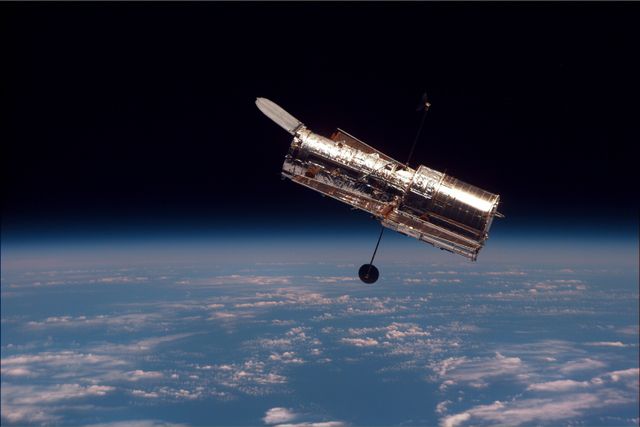 The
Hubble Space Telescope as seen from space shuttle Discovery during its
second servicing mission. Hubble, which orbits 600 kilometers above
Earth, has been a keystone of astronomical investigations for the past
twenty-five years.
 The
Andromeda Galaxy is the nearest major galaxy to the Milky Way. It is
the largest and most massive galaxy of the Local Group, a collection of
about 45 galaxies to which the Milky Way belongs. It contains an
estimated one trillion stars.
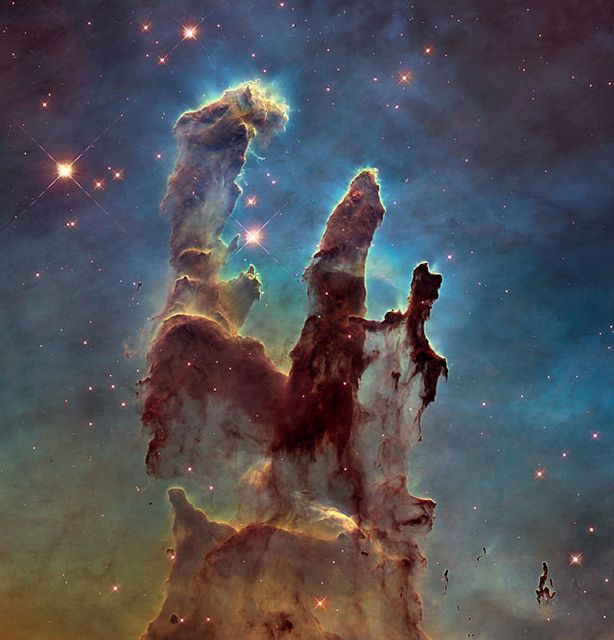 The
“Pillars of Creation”, a part of the Eagle Nebula containing a large
amount of gas, dust and newly born stars. The leftmost pillar is about
four light years in length, approximately the distance from the Sun to
its nearest stellar neighbor.
 The
Hubble eXtreme Deep Field, taken in 2012 over twenty-three days. Except
for a few stars, everything in this image is an entire galaxy, some of
which are 13.2 billion years old.
 The
Lagoon Nebula is between 4,000 and 6,000 light-years from Earth and was
first discovered in 1654. It contains a central structure known as the
Hourglass Nebula, within which were the first direct observations of
active star formation by accretion.
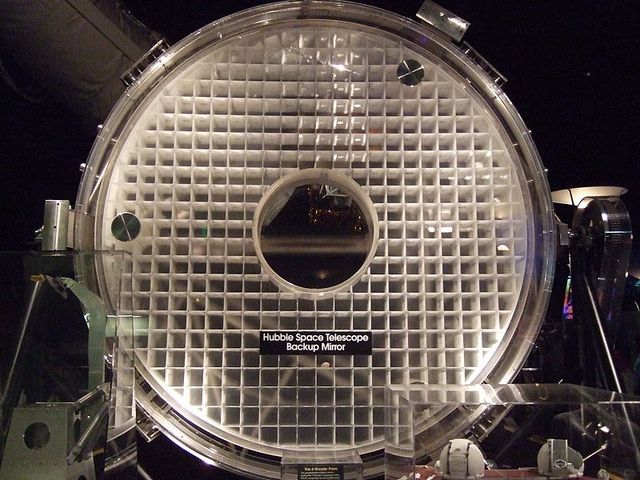 The
uncoated backup mirror for the Hubble Space Telescope produced by
Kodak. When the aberration in Hubble’s primary mirror was discovered,
NASA realized that they had launched a flawed mirror while a perfect one
remained on the ground. This mirror has never been used and currently
resides at the Smithsonian Institution Aerospace Museum.
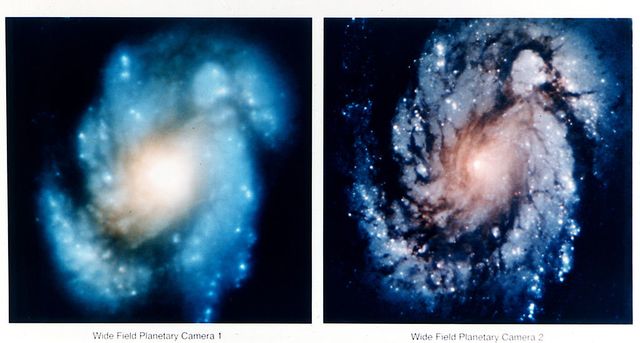 The
spiral galaxy M100, imaged before and after Hubble’s corrective optics
were installed. The dramatic improvement in image quality has allowed
the telescope to obtain images of both the formation of stars and the
collisions of distant galaxies.
 NGC
5257 and NGC 5258, two spiral galaxies in the constellation Virgo. Both
are distorted by their mutual gravitational interaction and are
connected by a thin bridge of matter shared between the two. This sort
of imagery would have been impossible if Hubble’s optics had not been
corrected.


