Tuesday, October 9, 2018

Marriot Hotel Workers Strike Spreads to Hawaii - 9 Oct 2018


Marriott hotel workers strike spreads to Hawaii

9 October 2018

More than 2,700 hotel workers in Honolulu and Maui walked off the job on Monday, joining Marriott workers who began striking last week in the San Francisco area. Nationwide, 7,700 workers from 23 hotels are now on strike in eight cities. Strikes are ongoing in Boston, San Francisco, San Jose, Oakland, San Diego and Detroit.

Workers picketed five Marriott hotels in Hawaii: Sheraton Waikiki, Royal Hawaiian, Sheraton Princess Kaiulani, Westin Moana Surfrider and Sheraton Maui. About 95 percent of the 3,500 workers in Local 5 authorized a strike last month. However, workers at Waikiki Beach Marriott and the Sheraton Kauai, who voted to strike, were still working on Monday morning.

The owners of the Hawaiian hotels, Kyo-ya Hotels & Resorts, issued a statement the same morning stating the company has “implemented contingency plans” to continue operating the five hotels on strike while adding “there have been some adjustments to staffing levels and services being offered at our properties.”

The strike in Hawaii comes after months of negotiations over job security, improved wages and work overloads. Workers also want a say in how new technological changes can improve working conditions rather than lead to the elimination of jobs.

Jenny Johnson, a dinner cook at Sheraton Waikiki for the last seven years, told Hawaii News Now, “We’re asking for one job to be enough,” adding, “We want a fair contract so that our members can work and afford to put food on their table and still be able to sit down and enjoy their dinner with their families.”

In a news release, the president of UNITE, Donald Taylor, declared that “UNITE-HERE union members are going to change the lives of all workers in our industry.”  Hotel workers in Chicago have been scraping by with $300 to $400 a week in strike pay. Hotel workers in Detroit, who began their strike Sunday morning, are not currently receiving strike pay.

Taylor and the top executives at UNITE-HERE receive six-figure annual salaries, with Taylor alone making $315,000, more than ten times what hotel workers make on average. Union workers also have to pay almost $700 a year in dues.

Now that workers in Hawaii have joined the growing national hotel strike, it is critical that workers break from the isolation and appeal to trade union workers and others to honor picket lines and refuse to work or deliver anything to the struck hotels.

Nothing can be won through isolated, individual strikes.  Making lots of noise at the front of the hotel while deliveries are quietly made to the back and side doors is not an effective strike tactic.  Taking pickets from one hotel and combining them with pickets at another hotel to make a large raucous crowd may build a little spirit, but hotels that are on strike should have pickets at every entrance and exit.  Strike leaders seem to think that creating loud publicity is the way to win strikes.

http://www.hawaiinewsnow.com/story/39017093/thousands-of-hawaii-hotel-workers-protest-for-better-wages/


Sunday, October 7, 2018

Boston MA: Edmonton Oilers Hockey Team Cross Striking Hotel Workers Labor Union Picket Line – 7 Oct 2018


Edmonton Oilers Cross Picket Line
Boston MA (6 Oct 2018) Hotel workers were on strike and on the picket lines in front of Boston’s Ritz-Carleton Hotel on Sunday afternoon when members of the Canadian hockey team crossed the picket line on at the Avery Street hotel.  With visible picket signs and bullhorns leading chants such as: “Don’t Check in, check out!” the members of the team carrying their bags and hockey sticks clearly knew they were crossing a striking workers picket line.  Hotel security agents escorted the players inside the struck hotel as workers called out “Scab!”  The team is part of the NHL and they are also union members.  Picket lines mean – Don’t Cross! Anyone in a labor union or is a union supporter who sees a picket line at a place of work should refuse to cross the line and avoid going into the struck business.  Labor unions must build picket lines that no one dares to cross. 


Edmonton Oilers Scabs

US General Prepped Nuclear Bombs to Drop on North Vietnam as the US Was Losing on the Battlefield - 7 Oct 2018

US general made preparations behind president’s back to nuke Vietnam, declassified memo shows

US general made preparations behind president’s back to nuke Vietnam, declassified memo shows
The commander of US forces in Vietnam had devised a secret plan to use nuclear warheads against the communist North during the Vietnam War, before President Johnson halted the ongoing preparations, declassified documents reveal.  General William Westmoreland, who commanded American military operations in the Vietnam War from 1964 to 1968 had authorized a nuclear weapons transfer to the Southeast Asian nation, before national security advisor, Walt W. Rostow, notified the White House, prompting President Lyndon Johnson to immediately cancel the secret deployment of weapons, which could have sparked World War III, the New York Times reports, citing declassified documents.
...................................
Read more
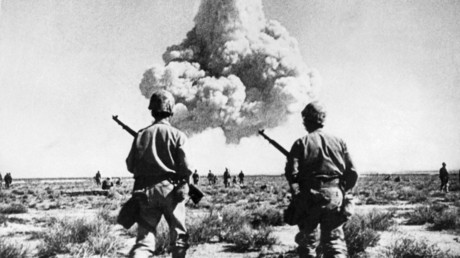
US troops during nuclear tests in Nevada. April 1952 © Intercontinentale  
 
Finding themselves in a stalemate against the North Vietnamese Army (NVA) in the middle of the months-long Battle of Khe Sanh, Gen. Westmoreland devised a contingency scheme to use nuclear weapons should US forces be overrun by their enemy. The secret plan codenamed Fracture Jaw required the US nukes to get transferred from Okinawa, Japan to South Vietnam by the US Pacific command, under the leadership of Admiral Ulysses Simpson Grant Sharp Jr. The secretly planned operation was to be set in motion under a memo sent by Westmoreland to Sharp on February 10, 1968.

Once President Johnson was alerted about the plan by his national security advisor Rostow through an “eyes only” memorandum to the president, he immediately put a halt to the operation.
“When [President Johnson] learned that the planning had been set in motion, he was extraordinarily upset and forcefully sent word through Rostow and, I think, directly to Westmoreland, to shut it down,” Tom Johnson, a special assistant to the president at the time, told the NYT. According to special assistant Johnson, despite pressing the US generals to win the Battle of Khe Sanh, the 36th President feared a “wider war” could break out with China should the conflict escalate further.
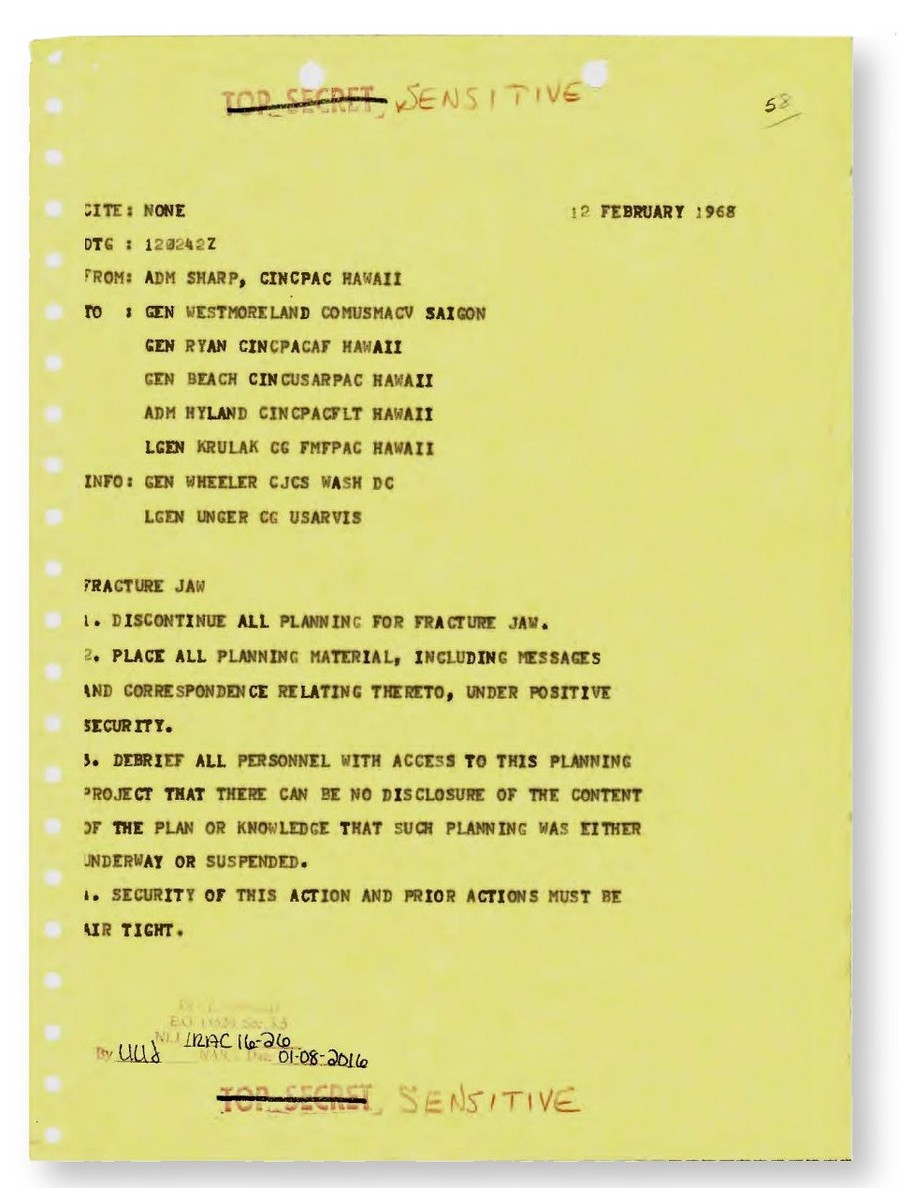
Once word of the scheme reached the White House, Admiral Sharp was immediately ordered to “discontinue all planning for Fracture Jaw,” declassified documents dated February 12, 1968 show. Sharp also ordered staff to “place all planning material, including messages and correspondence relating thereto, under positive security,” noting that information about the secret operation “must be airtight.”
“Johnson never fully trusted his generals,” said the former assistant. “He had great admiration for General Westmoreland, but he didn't want his generals to run the war.”


The Battle of Khe Sanh, fought in northwestern Quảng Trị Province, was one of the epic clashes fought between the Americans and the North Vietnamese communist soldiers during the Vietnam War. At the start of the engagement on January 21 some 6,000 US Marines and South Vietnamese Army soldiers engaged around 20,000 men from the North Vietnamese Army (NVA). Up to 45,000 US soldiers and up to 100,000 North Vietnamese fighters would take part in the 77-day battle, in which both sides claimed victory.

Archive

Saturday, October 6, 2018

Because of Low 44% Turnout - Teamsters Bureacratic Misleaders Defy 'No' Vote - Declare UPS Contract Ratified - 6 Oct 2018

6 October 2018

On Friday, UPS workers voted to reject a sellout contract backed by the Teamsters union leaders and UPS management. The union bureaucrats, however, have announced that it considers the contract ratified and will seek to impose it in the face of mass opposition.

The ballot results were released last night, with 50,248 workers (54.7 percent) voting against and 42,356 (45.74 percent) in favor. Workers at the subsidiary UPS Freight voted against a separate contract by 4,255 to 3,794, a margin of 62.06 percent. Both votes follow the “no” vote by 1,300 UPS airline mechanics in Louisville, Kentucky on Wednesday, meaning all three of the Teamsters’ contracts have been defeated.

(The UPS depot in Madison Heights, Michigan)
 
The Teamster misleaders are citing an anti-democratic clause in its constitution that provides the bureaucracy with virtually unchallengeable authority against the rank and file workers. The clause states that if turnout on the contract vote is less than half, a two-thirds majority of workers is required to reject the final agreement. Voter turnout on the national UPS agreement was 44 percent.

The Teamsters leadership's statement cynically attempts to blame those workers who did not participate in the vote. “As we saw in the 2016 U.S. Presidential election,” it declares, “winning the popular vote does not necessarily win the election when the Constitution requires you to win the Electoral College vote. As Teamsters, we too must abide by the rules in our Constitution. Thus, the National Master UPS Agreement has been ratified.”

Nervous of a wildcat strike, the Teamsters leaders statement threatens: “You are reminded that the terms of the 2013 Agreement remain in effect, including the no strike/no lockout clause.”

In effect, the union tops are counting those workers who did not vote as votes in favor of its agreement. No organization that was in any way accountable to workers could have such rules. Why is a two-thirds majority not required to ratify the agreement, rather than to reject it?

From the beginning, the Teamsters leadership has done everything it could to force through a sellout agreement over mass opposition. In July, workers voted overwhelmingly for strike authorization, by 93 percent, a vote that the union has simply ignored.

After reaching a sellout agreement with the company, the Teamsters tops then dispatched local officials across the country to threaten workers with the loss of health insurance if they went strike and declared that rejecting the contract would lead to a worse deal. It has spent workers’ dues money to hire the marketing firm BerlinRosen to promote leadership lies. And it has kept workers on the job for three months without a contract to buy time to wear down overwhelming anger over its sellout.
Many workers have raised concerns about the integrity of the voting process. Several workers reported on 5 October, the final day of voting, that they had still not received their form in the mail providing an electronic online voting code. This is the first year that the Teamsters has used electronic voting on its contract.

Now, to justify the union bureaucracy efforts to repudiate the clear will of UPS workers, the Teamsters bosses are claiming that it is merely upholding its constitution. However, during the vote on the last contract, the Teamsters leadership ignored overwhelming defeats of local supplementary agreements to push through the national master contract, violating its own statutes. In that case, the Teamsters leadership amended the constitution to override the votes at locals.

The Teamsters leadership is also refusing to call a strike at UPS Freight, where the turnout was approximately two thirds of the workforce. It has declared that it will request further negotiations with the company—and will force workers to vote again. We need labor union leaders who think like workers, not like bosses; we need labor union leaders who aren't afraid of going to jail.  Old school Jimmy Hoffa, for all of his problems, understood the role of a union leader during negotiations for 'more' and during a strike.  "If you're not going to jail, you're not doing your job," Hoffa said. 

Friday, October 5, 2018

The #MeToo campaign versus the presumption of innocence By Eric London 5 October 2018


In the US, the Democratic Party and its celebrity and media allies, through the vehicle of its #MeToo campaign, are waging a battle against the presumption of innocence. By seeking to whip up hysterical moods surrounding allegations of sexual misconduct, they are trying to popularize the idea that those accused of sexual assault should be presumed guilty. This campaign is, in its essence, reactionary and should be opposed.

The proponents of this view have put forward four primary arguments:

1. All accusers must be believed, and doubting any accuser is tantamount to “victim blaming” or “rape apology.” The actress Rose McGowan said in December 2017, “I would challenge the media to stop using the word ‘alleged.’ My beef is really with all the people who are complicit. It’s the first time in history women are being believed, even though we get slagged.”

2. The impact of such crimes on victims is so devastating that basic protections for the accused are obstacles in the way of justice, not only for the particular accuser, but for women as a whole. Hawaii Democratic Senator Mazie Hirono recently said the presumption of innocence “is what makes it really difficult for victims and survivors of these traumatic events to come forward.”

3. It is a mark of unfairness and gender bias that the accused have the right to cross-examine their accusers, which #MeToo proponents such as the International Socialist Organization call “put[ting] rape victims on trial.”

4. The presumption of innocence is not a democratic principle but a mere legal technicality, and as such it applies only in a criminal prosecution. As New York Democratic Senator Charles Schumer said, there is “no presumption of innocence” in the case of Supreme Court nominee Brett Kavanaugh because “it’s not a legal proceeding. It’s a fact finding proceeding.”

When considered in a historical context, the anti-democratic character of these arguments emerges. For centuries, proponents of the democratic right to the presumption of innocence have fought against powerful moods, based on appeals to emotion, mob justice and irrationalism, which view the presumption of innocence as an obstacle in the way of exacting immediate revenge against the alleged perpetrator. Proponents have always insisted that the principle is meaningless unless it applies universally, even to (and especially to) individuals who find themselves in the crosshairs of official public opinion.

The #MeToo campaign’s arguments against the presumption of innocence have reared their heads before, including at the ugliest moments in US history. They run counter to the centuries-long historical struggle for due process and the rights of the accused.

The origins of the presumption of innocence

The right to the presumption of innocence until proven guilty is among the foundational principles upon which many other significant legal protections depend. If the accused are presumed guilty, then the right to counsel, the right to cross-examine witnesses, and the right to remain silent would be substantially weakened.

According to the attorney François Quintard-Morénas, as early as the 4th century BC the Greek orator Demosthenes put forward the position that “one merely accused of murder cannot yet be called a murderer, for no man comes under that designation until he has been convicted and found guilty.” In 212 AD, the constitution of the Roman Emperor Antonin enshrined the legal maxim actori incumbit probatio, or, “he who wishes to bring an accusation must have the evidence.”

It was in the 13th and 14th centuries with the development of the jus commune, however, that the presumption of innocence first crystalized into a fundamental legal principle. The adoption of jus commune marked a revolution in legal forms, replacing the unwritten custom-based European law of the high Middle Ages with a more advanced, written common law system that combined a revitalized Roman legal framework based on procedure with Catholic canon. It was the French lawyer Johannes Monachus who first used the phrase item quilbet presumitur innocens nisi probetur nocens—“a person is presumed innocent until proven guilty.”

Johannes Monachus
 
As Catholic University law professor Kenneth Pennington notes, this principle “summarized the procedural rights that every human being should have no matter what the person’s status, religion, or citizenship.” It “protected defendants from being coerced to give testimony and to incriminate themselves. It granted them the absolute right to be summoned, to have their case heard in an open court, to have legal counsel, to have their sentence pronounced publicly, and to present evidence in their defense.”

Pennington explains that the presumption of innocence came under attack in the late medieval and early modern period. During the Inquisition, many European Jews were accused of sexually assaulting Christian women and were burnt or otherwise killed.

In one such case in 1398 or 1399, Papal Judge Johannes de Pogiali took the rare step of conducting an investigation into the facts underlying the accusations. Discovering that the particular accusations were false, de Pogiali concluded: “It was better to leave a crime unpunished than to condemn an innocent person.” Pennington adds, “Many will recognize in these words ‘Blackstone’s ratio:’ ‘the law holds that it is better that ten guilty persons escape than one person suffer.’”

In the 15th through the 17th centuries, the right to the presumption of innocence was affirmed in papal letters requiring that Jews be granted the right to counsel and to know the names of their accusers.

The emergence of presumption of innocence coincides with the earliest development of bourgeois law. The presumption was advanced in opposition to the medieval torture chamber, where the accused person was simply tortured until he “confessed.” Under this regime of torture, the court proceeding consisted merely of the confessed sinner being brought before a tribunal to acknowledge his confession.

“Must we assume that witches are guilty?” asked German Jesuit professor Friedrich von Spee, an early opponent of torture, in his 1631 work Cautio Criminalis. “I assume that no one can be condemned unless his guilt is certain: an innocent person ought not be killed. Everyone is presumed innocent, who is not known to be guilty.”
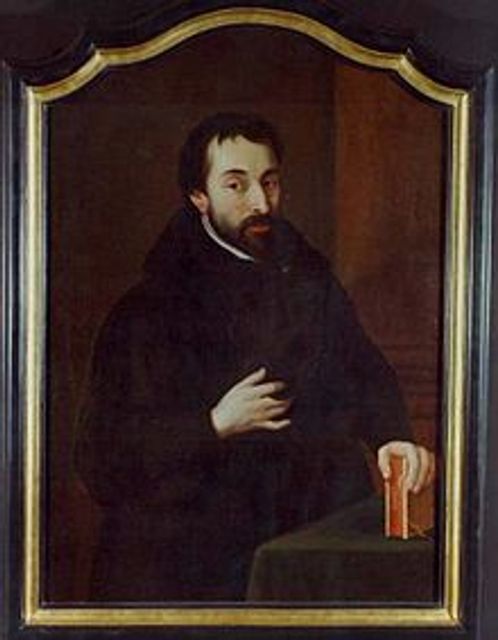
Friedrich von Spee
 
In the 18th century, the revolutionary European and American bourgeoisies were determined to deliver a blow against centuries of feudal backwardness and arbitrary dynastic rule. Their chief ideologists, schooled in the ideas of the rational Enlightenment, recognized the presumption of guilt as a characteristic of tyranny that is wholly inconsistent with democracy and the rule of law.
The revolutionaries rejected the notion that rights could be granted or rescinded by the state at will. Rather, rights were vested in “the people” themselves, and the maintenance of the rule of law meant protecting them from the power of the government. In this sense, the American Declaration’s “right to revolution” is incompatible with the presumption of guilt. Strong, repressive states justify their existence based on suspicion of the population and the need for social control.

It was a rejection of this reactionary view that guided the revolutionaries and led John Adams to remark in relation to the presumption of innocence that “there was never a system of laws in the world in which this rule did not prevail.” Benjamin Franklin expanded Blackstone’s ratio by a factor of ten, declaring “it is better 100 guilty Persons should escape than that one innocent Person should suffer.”

Similarly, during the French Revolution, Quintard-Morénas explains that the third estate viewed the monarchy’s use of torture and its belief in the presumption of the guilt of its subjects as an indication of the regressive character of the Bourbon dynasty:

“The relative indifference of the population to the plight of accused criminals, combined with the widely shared opinion among jurists that torture was not a punishment and that humanizing criminal procedure would encourage crime, contributed to maintain a practice that increasingly fell into disuse in France at the end of the seventeenth century.”

The representatives of the third estate who gathered at the Estates-Generals in 1789 “referred to the presumption of innocence to request a better treatment of suspects and their complete absolution in the event of insufficient evidence.” The presumption was enshrined in the French Declaration of the Rights of Man and serves as the foundation for the US Constitution’s Bill of Rights.

A legal formality or essential democratic principle?

Particularly prominent today is the argument that the presumption of innocence is a legal technicality that applies only in a court of law and otherwise has no broader applicability. These arguments evidence an ignorance of history and the absence of democratic consciousness on the part of those who have been swept up in this campaign.

When hundreds of people were dismissed from government jobs or positions in Hollywood based on allegations they were spies for the Soviet Union because of sympathies for left-wing politics, they were provided no opportunity to challenge their persecutors.

As Robert Goldston noted in his book The American Nightmare: Senator Joseph R. McCarthy and the Politics of Hate, a victim of the McCarthyite witch-hunt was “presumed guilty until he could prove his innocence. He was not permitted to know who his accusers were or to face them… He was not even permitted to know what the specific charges were against him! He was simply to know that he was considered disloyal unless he could prove his loyalty.”

Supporters of the #MeToo campaign presumably have no objection to this regime, since after all, these were not criminal proceedings and the presumption of innocence does not apply.
In the US Supreme Court’s milestone 1895 decision Coffin v. United States, the convictions of two men were overturned because the judge failed to specifically instruct jurors about the presumption of innocence.

The US Supreme Court ruled that even though the judge had instructed the jury that the prosecution had to prove the defendants’ guilt beyond a reasonable doubt, if the jury did not properly understand the fundamental importance of the presumption of innocence, the process would be fundamentally unfair and in violation of due process. The Supreme Court called the presumption of innocence “the undoubted law, axiomatic and elementary.”

The Supreme Court explained that without an understanding of the presumption of innocence, no jury could fairly determine a defendant’s guilt beyond a “reasonable doubt” because the presumption of innocence is not merely a status but is rather evidence that tends to show the innocence of all accused of crimes. By failing to instruct the jury about the presumption of innocence, therefore, the lower court judge was withholding evidence of the defendants’ innocence from the jury. The Supreme Court wrote:
The evolution of the principle of the presumption of innocence, and its resultant, the doctrine of reasonable doubt, make more apparent the correctness of these views, and indicate the necessity of enforcing the one [the presumption of innocence] in order that the other [the requirement that guilt be proven beyond a reasonable doubt] may continue to exist. While Rome and the Mediaevalists taught that wherever doubt existed in a criminal case, acquittal must follow, the expounders of the common law, in their devotion to human liberty and individual rights, traced this doctrine of doubt to its true origin—the presumption of innocence—and rested it upon this enduring basis.
In an 1897 article in the Yale Law Journal, Professor James Bradley Thayer argued against the Coffin decision and wrote, “The presumption of innocence has been overdone in our hysterical American fashion of defending accused persons.”

According to Thayer, the presumption of innocence should not require special jury instruction because it makes conviction far too difficult. It was a mere legal technicality, he argued, and not evidence in favor of the accused. It “plays a very small part indeed” in American life and should provide no further legal or social protections for the accused.

By requiring that jurors be specifically instructed about the importance of the presumption of innocence, the Supreme Court, in an era where it could still articulate essential democratic conceptions, was explaining that the presumption of innocence must be broadly grasped in social consciousness if it is to retain any significance, even in a criminal legal setting. It is a bulwark against all forms of jury bias, including racial prejudice. Democratic rights are hollow if they are not understood by jurors and potential jurors. Every jury pool will be tainted if the presumption of innocence is not recognized in social consciousness.
As Quintard-Morénas writes:
[The presumption of innocence] challenges the very foundation of a social contract in which society, by prohibiting private vengeance and guaranteeing the right to be tried by an impartial jury, acknowledges that there is a time for innocence and a time for guilt. All too often suspects are treated as guilty by a society that owes them protection, even in light of the appalling nature of the alleged crime. But one cannot expect society to treat the presumption of innocence as an ‘article of faith’ outside the courtroom if those in charge of applying the law overlook the rationale for the maxim.
The US Supreme Court ultimately scaled back the presumption of innocence, including in a 1979 case titled Bell v. Wolfish, which allowed pre-trial detention of those accused but not convicted of crimes on the grounds that the presumption of innocence does not apply until the time of trial. This decision is responsible for drastically expanding the size of the population detained in local jails while awaiting trial. Justice Thurgood Marshall denounced the Wolfish majority opinion at the time, writing that “the Supreme Court decided the presumption didn’t exist at all.”
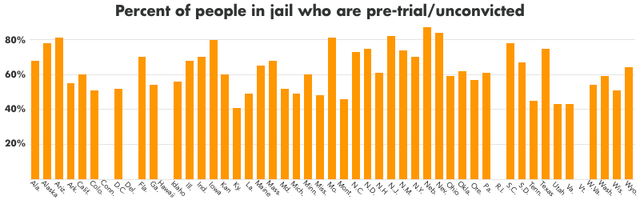
Source: Prisonpolicy.org
 
By hollowing out the presumption, #MeToo is paving the way for future frame-ups and convictions, in particular of the millions of poor and oppressed who are often caught up in the gears of the criminal system and become the victims of prejudices—racial and otherwise—of juries who do not understand the presumption of innocence.

The absence of the presumption of innocence and lynch law

The proponents of the #MeToo campaign attempt to present the position that all accusers must be unquestionably believed as a “left-wing” view. They characterize as “progressive” the idea that those who defend the accused are “rape apologists” and that requiring an accuser to subject herself to cross-examination is unfair and “places the victim on trial.” These are presented as basic principles of the struggle for women’s rights.

Nothing could be further from the truth. This is not the first time in American history that such arguments against the presumption have been made.

According to the Tuskegee Institute, 3,446 African-Americans were lynched from 1882 to 1968. The instigators and participants of lynch mobs acted under the belief that the legal system failed to believe accusers and slowed justice by providing unnecessary protections for the accused.
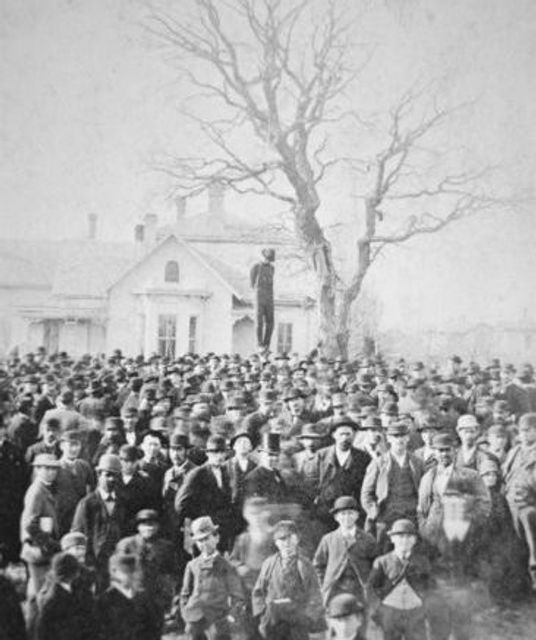
Frank McManus, lynched on accusation of rape in Minnesota, 1882
 
Sexual assault of white women was a common accusation levied against black men during this period. Because rape and sexual assault are among the most brutal and degrading crimes, accusations generated a degree of emotional fervor that made the facts underlying each accusation irrelevant for those involved. Appeals to due process were viewed as “tricks” by lawyers to give the guilty free reign to rape and defile white women.

In his 2017 book The Republic For Which It Stands: The Untied States During Reconstruction and the Gilded Age, 1865-1896, Stanford Professor Richard White wrote of the fight by civil rights leader Ida B. Wells to expose the use of rape and sexual assault accusations as a mechanism for murdering black men.

White wrote:
[Wells] discovered that no matter what the original reason for mob violence, newspapers turned them into stories of the rape of a white woman by a black man. Wells showed that in some cases the rape accusations disguised consensual sex, and in most other cases the original reasons for the lynchings had nothing to do with rape at all. Accusations of rape were, she wrote, “an old racket.” Her attacks struck at the core of the mythic South: the purity of Southern womanhood and homes threatened by black men. Memphis papers attacked her “obscene intimations” and a mob destroyed her press and threatened to kill anyone who tried to resume publishing.
One of Wells’ chief opponents was the prominent feminist temperance movement leader Frances Willard, who supported racial segregation and claimed that lynch justice was a lamentable but necessary way to protect white women from “great dark-faced mobs.”
In 1894, Wells denounced Willard when the latter claimed that white women must be believed when making accusations of sexual assault or rape. White wrote:
Willard attacked [Wells] for slandering Southern white women by saying that not all accusations of rape were true. The WCTU [Woman’s Christian Temperance Union] resolution of 1894, although lamenting lynching, indicated that it could not be banished until “the unspeakable outrages which have so often provoked such lawlessness [i.e., sexual assault and rape allegations] shall be banished from the world, and childhood, maidenhood, and womanhood shall no more be the victims of atrocities worse than death.”
To Wells, the presumption of innocence was what stood between life and death for thousands of black men across the South. She dedicated her career and risked her life to defend this presumption against the hysteria of moralists who claimed that any black man against whom an accusation was levied must be guilty.
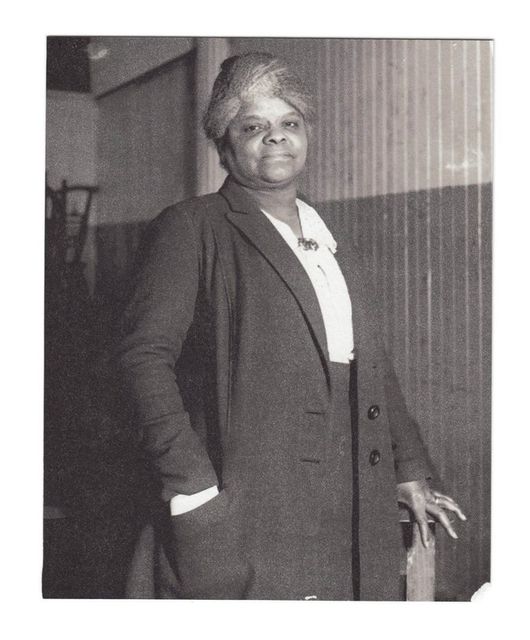
Ida B Wells
 
In an 1893 article titled “Lynch Law,” Wells wrote that 269 black men were murdered by mobs after being accused of rape between 1882 and 1891. She wrote, “This crime is only so punished when white women accuse black men, which accusation is never proven… Investigation as to guilt or innocence of the accused is never made.”

In 1900, Wells wrote an article titled, “Lynch Law in America,” which warned against condemning a man “upon the unsworn and uncorroborated charge of his accuser.” The article continued: “No matter that our laws presume every man innocent until he is proved guilty; no matter that it leaves a certain class of individuals completely at the mercy of another class… if a white woman declares herself insulted or assaulted, some life must pay the penalty, with all the horrors of the Spanish Inquisition and all the barbarism of the Middle Ages. The world looks on and says it is well.”

In 1892, Wells denounced those who claim accusers should be protected from testifying because of the trauma they have allegedly endured as victims of sexual assault. She attacked a Southern bishop who said those “who condemn lynching express no sympathy for the white woman in the case.” Referring to a lynching in Chestertown, Maryland, Wells wrote:
When that poor Afro-American was murdered, the whites excused their refusal of a trial on the ground that they wished to spare the white girl the mortification of having to testify in court.

This cry has had its effect. It has closed the heart, stifled the conscience, warped the judgment and hushed the voice of press and pulpit on the subject of lynch law throughout this “land of liberty.” Men who stand high in the esteem of the public for Christian character, for moral and physical courage, for devotion to the principles of equal and exact justice to all, and for great sagacity, stand as cowards who fear to open their mouths before this great outrage. They do not see that by their tacit encouragement, their silent acquiescence, the black shadow of lawlessness in the form of lynch law is spreading its wings over the whole country.
Wells demanded that accusers stand before their accused and answer difficult and perhaps embarrassing questions about their accusation. She rejected the idea that white women were too fragile or emotionally weak to explain themselves. She denounced those in the press who undercut the presumption of innocence and helped make it possible for mobs or juries to convict innocent men.

The decline of democratic consciousness and the war on terror

The fact that such arguments could find such a broad hearing today among the oligarchy and the affluent upper-middle class testifies to the advanced state of decay of democratic consciousness. An important experience in setting the conditions for this degeneration is the ongoing “war on terror.”
The “war on terror” involved an attempt to whip up mass hysteria that could be used to undermine democratic rights, presenting the public with a great evil that was supposedly too extreme, too horrible, and too urgent to justify maintaining basic democratic principles.
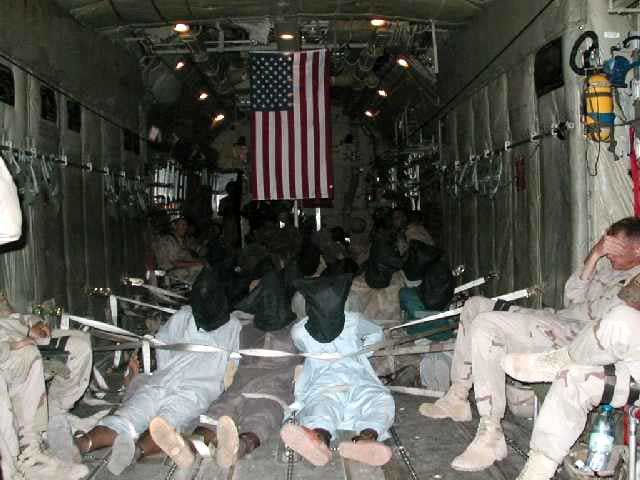
Detainees in the war on terror
 
Pursuant to the “war on terror,” countless individuals were abducted, imprisoned, and tortured without ever having been convicted of a crime. Once they were designated as “unlawful enemy combatants,” they could be held indefinitely without trial. The presumption of innocence, of course, was unavailable to the victims of the Guantanamo Bay torture camp and the CIA’s network of black site prisons around the world.

This applies to individual terrorist suspects as well as entire societies. Alongside individuals like José Padilla and John Walker Lindh, the entire nation of Iraq was presumed guilty of involvement in the September 11 events as well as producing “weapons of mass destruction.” The war that was launched on this presumption of guilt resulted in the deaths of over one million people.

The outlook of the US government in prosecuting the war on terror was epitomized by George W. Bush’s vice president, Dick Cheney, who said he still supported the use of torture against suspected terrorists although 25 percent of torture victims were later proven innocent.

“I’m more concerned with bad guys who got out and released than I am with a few that in fact were innocent… I have no problem as long as we achieve our objective… I’d do it again in a minute.”
The timeline of events following September 11, 2001 shows how the government used widespread confusion and emotional sympathy for the victims of the attack to whip up blind nationalism and belief that those accused of terrorism did not deserve to benefit from constitutional protections.
On November 13, 2001, the Bush administration issued an executive order allowing “individuals… to be detained, and, when tried, to be tried for violations of the laws of war and other applicable laws by military tribunals,” instead of held pursuant to the Geneva Convention, which mandates the humane treatment of prisoners of war.

At the Guantanamo Bay prison as well as a network of black site prisons around the world, the US government engaged in the systematic torture and brutalization of “unlawful enemy combatants” whom it held without charge.

A new category of super criminal—“terrorist”—was promoted by the corporate media and the political establishment. A powerful campaign to generate jingoist and pro-war sentiments brought immense pressure to bear against anyone who defended the democratic rights of suspected terrorists. These rights were presented as burdensome obstacles to thwarting the “next 9/11.” All those who questioned the government were labeled as “anti-American” or subject to state surveillance under the PATRIOT Act.
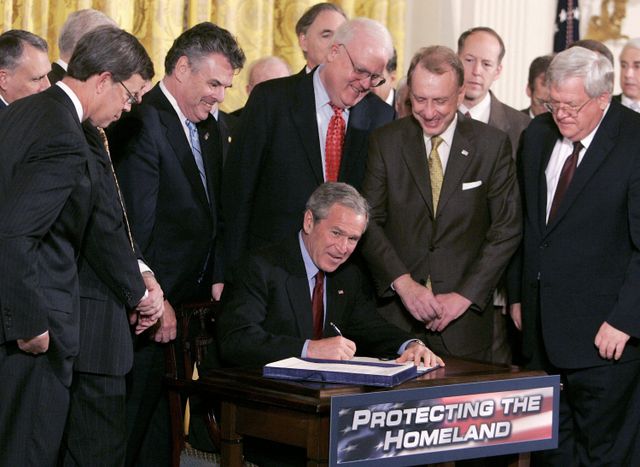
The signing of the PATRIOT Act
 
In 2006, the Democrats and Republicans passed the Military Commissions Act of 2006, which held that enemy combatants who were not US citizens could not seek habeas corpus relief and had no right to challenge their detention. In 2008, the Supreme Court ruled in Boume diene v. Bush that military commissions were acceptable and that detainees did not have to be tried in criminal court, but that detainees did have the right to file habeas corpus petitions.

Under the administration of Bush’s successor, Barack Obama, the attack on the presumption of innocence reached unprecedented levels. The government set up a secret “kill list” comprised of targets of drone strikes.

On September 30, 2011, the military-intelligence agencies assassinated a US citizen, Anwar al-Awlaki, in Yemen without a warrant or trial, presuming him guilty based on briefings from an intelligence file. Two weeks later, the Obama administration murdered al-Awlaki’s 16-year-old son, Abdulrahman al-Awlaki. The Obama administration also kept the Guantanamo Bay prison open, and the prison has detained a total of 779 people since January 2002, many of whom were innocent.
The anti-democratic impact of the ongoing war on terror has poisoned and degraded all aspects of official political, legal and cultural life. As Washington University law professor Leila Dadya Sadat said in a 2008 speech titled “A Presumption of Guilt: The Unlawful Enemy Combatant and the US War on Terror:”
This dehumanization of a whole category of human beings—the “suspected terrorist” or “unlawful enemy combatant”—has had pernicious effects upon the American legal system and severely harmed America’s international standing. These doctrines and the propaganda supporting them have led to the systematic use of torture and cruel, inhuman and degrading treatment used on prisoners detained in the legal limbo known as Guantanamo Bay, Kandahar prison in Afghanistan and Abu Ghraib prison in Iraq, as well as the rendition of terror suspects to third countries and to “black sites” scattered around the world for detention, interrogation, mistreatment and sometimes death. Although most (but not all) of the individuals subjected to this regime have been foreigners, the impact of this Executive Activism has been on the American legal regime and the American psyche, for it has been US investigators, US courts, and US lawyers, that carried out the government’s plan. Indeed, these policies have turned US legal principles upside down, resulting in a presumption of guilt applicable to anyone accused of acts of terrorism by the government.
The powerful anti-democratic tendencies unleashed by the government in the conduct of the war on terror have advanced the erosion of democratic consciousness and seeped into all aspects of domestic law.

Thousands of victims of police murder in the US do not receive the benefit of the presumption of innocence. They are presumed guilty as a result of living in “high-crime areas,” where the police shoot first and ask questions later. Instead, police on the beat, armed with the latest weaponry from the battlefields of North Africa, the Middle East and Central Asia, serve as judge, jury and executioner and are hardly ever punished.

Tens of millions of undocumented immigrants, whose very presence in the US has been deemed “illegal” by the same laws aimed against “terrorists,” can be dragged out of their homes or off the job, separated from their loved ones, thrown into cages and forced to face physical and sexual abuse in detention centers for months or years on end.
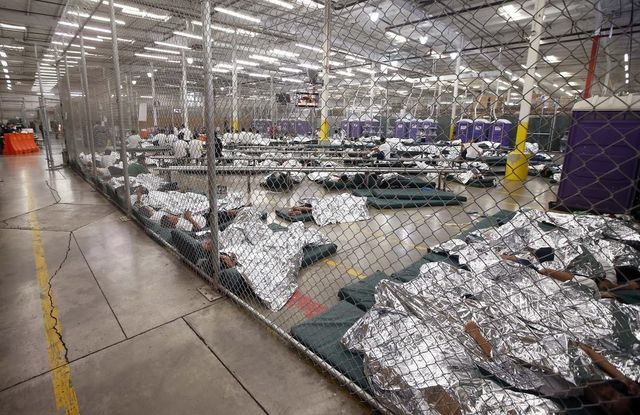
Immigrants detained in US detention centers
 
Eight million people are either in prison, jail or on parole or probation. That arrestees who have not been convicted of a crime can be held in jail while they await trial is no longer even a matter for debate.

Who can claim the United States suffers from too much attention to the presumption of innocence?

Postmodernism, identity politics and the presumption of guilt

The abandonment of progressive attitudes toward due process and the presumption of innocence is most pronounced among affluent sections of the upper-middle class. For this privileged layer, identity politics and postmodernist philosophy have become key theoretical vehicles for the attack on the presumption of innocence.

Proponents of this view have leapt to defend the accusers in several instances where the accusations were false. In the Tawana Brawley, Duke Lacrosse and University of Virginia Rolling Stone cases, the media and supporters of identity politics assumed that the accused must be guilty because they were white men.

In a recent comment in support of the #MeToo campaign on their blog, the ex-radicals Alex Steiner and Frank Brenner sum up the reactionary marriage between identity politics and postmodernism. Brenner denounces the WSWS for “harping on due process in a thoroughly bourgeois legalistic manner” by defending the presumption of innocence for those accused of sexual misconduct.
Due process may be warranted, Brenner writes, but “a far greater legal concern is the way in which women who bring sexual assault accusations to court are subjected to character assassination in order to undermine the credibility of their accounts,” which, he says, allows “perpetrators” to “walk free.” (Emphasis added). He praises the #MeToo campaign as a “spontaneous upsurge of the masses” that challenges the fact that “we have a category of crime where a great many women (and some men) are being abused, often scarred for life, and yet few perpetrators are ever brought to justice.”

Employing the language of the police by referring to “perpetrators” who must be “brought to justice,” Brenner invents a “right” of the accuser to be believed without question and explains that this is of “far greater legal concern” than due process for the accused. He appeals to the emotional damage suffered by “a great many women” and claims that women should be spared the humiliation of raising their accusations in court, where women face “character assassination”i.e. the Sixth Amendment right to cross-examine witnesses.

Brenner is making an argument for lynch mob justice. He is opposed to the fundamental conception that rights are intended to protect the population from state repression. Instead, he views the right of the accuser to be protected from uncomfortable questioning to be of “far greater legal concern” than the right to question whether the accuser is telling the truth.

Appeals to the “identity” of the alleged victim share much in common with the lynch mob instigators of the late 19th century, who claimed that no white woman would ever lie to a jury and that accusers should be protected from the embarrassment of giving testimony under oath. In this warped postmodernist view, the actual facts underlying the allegation are of no consequence.
In an earlier period of US history, progressive attitudes in defense of the right to the presumption of innocence found a wide cultural audience in beloved novels like Walter Van Tilberg Clark’s The Ox-Bow Incident and Harper Lee’s To Kill A Mockingbird, as well as in popular songs like Abel Meeropol’s “Strange Fruit” and Bob Dylan’s “Hurricane,” and films like Twelve Angry Men and Inherit the Wind.

If the promoters of the #MeToo campaign had been present at the trial of Tom Robinson in Harper Lee’s novel, they would have denounced Atticus Finch as a “rape apologist.” They would consider the “right” of Mayella Ewell to be believed to be “of far greater importance” than the right of Robinson to be presumed innocent. Finch would have been attacked for “harping on due process” in his appeals to the jury. When Finch posed difficult questions to Mayella and accused her of lying, the attorney would have been slandered for having engaged in “character assassination.” Brenner would say that Finch was helping “perpetrators” escape being “brought to justice.”
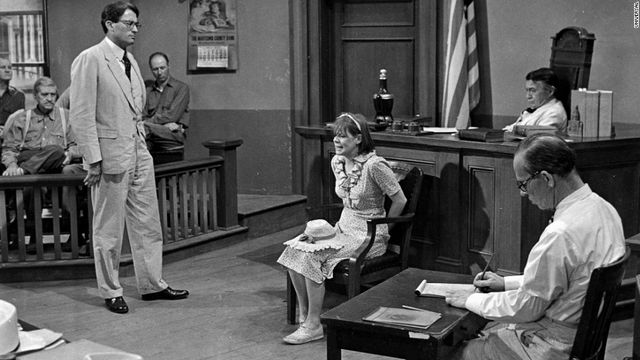
Gregory Peck as Atticus Finch cross-examines Mayella Ewell in the 1962 film version of To Kill a Mockingbird
 
The modern-day opponents of due process can claim all they want that they wish only to presume the guilt of the rich and powerful, not the oppressed. But the common law is based on precedent, and instigators of attacks on democratic rights do not have the luxury of deciding whose democratic rights will be violated and whose will not.

Whatever rules are established against the wealthy will be brought down upon the backs of the poor and defenseless with the ruthless force of the power of the state and public opinion.
In cases like the Scopes Monkey trial, the Sacco and Vanzetti frame-up, the Dreyfus Affair, the trial of Oscar Wilde, the Leo Franks case, the Leopold and Loeb trial and the frame-up of the Scottsboro Boys, the political left rejected calls for blood and vengeance and sought to expose the powerful interests fanning the flames of passion and prejudice.

Today, socialists reject the efforts of the proponents of the #MeToo campaign to undermine democratic consciousness and attack the presumption of innocence with all the old arguments of the extreme right.

The US military’s vision for state censorship of the internet - 5 October 2018

5 October 2018

In March, the United States Special Operations Command, the section of the Defense Department supervising the US Special Forces, held a conference on the theme of “Sovereignty in the information age.” The conference brought together Special Forces officers with domestic police forces, including officials from the New York police department, and representatives from technology companies such as Microsoft.

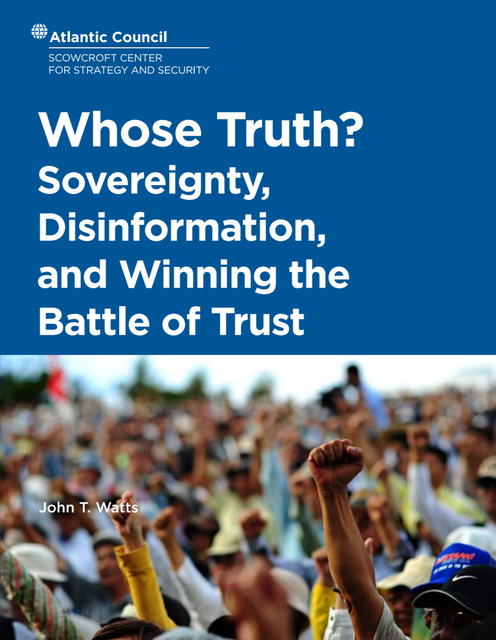
This meeting of top military and corporate representatives went unreported and unpublicized at the time. However, the Atlantic Council recently published a 21-page document summarizing the orientation of the proceedings. It is authored by John T. Watts, a former Australian Army officer and consultant to the US Department of Defense and Department of Homeland Security.

The Atlantic Council report

 
The Atlantic Council, a think-tank with close ties to the highest levels of the state, has been a key partner in the social media companies’ censorship of left-wing views. Most notably, Facebook acted on a tip from the Atlantic Council when it shut down the official event page for an anti-fascist demonstration in Washington on the anniversary of last year’s neo-Nazi riot in Charlottesville.
Confident that none of the hundreds of journalists in Washington will question, or even report, what he writes, Watts lays out, from the standpoint of the repressive apparatus of the state and the financial oligarchy it defends, why censorship is necessary.

The central theme of the report is “sovereignty,” or the state’s ability to impose its will upon the population. This “sovereignty,” Watts writes, faces “greater challenges now than it ever has in the past,” due to the confluence of growing political opposition to the state with the Internet’s ability to quickly spread political dissent.

Watts cites the precedent of the invention of the printing press, which helped overthrow the feudal world order. In the Atlantic Council’s estimation, however, this was an overwhelmingly negative development, ushering in “decades, and arguably centuries, of conflict and disruption” and undermining the “sovereignty” of absolutist states. The “invention of the internet is similarly creating conflict and disruption,” Watts writes.

“Trust in Western society,” he warns, “is experiencing a crisis. The 2018 Edelman Trust Barometer has tracked this erosion, showing a 30 percent drop in trust in government over the last year in the United States.”

Watts notes that this collapse in support for the government cannot be explained merely by the rise of social media. This process began in the early 2000s, “at the dawn of the social media age but before it had become mainstream.” Left out are the major reasons for the collapse of popular support for government institutions: the stolen election of 2000, the Bush Administration’s lies about weapons of mass destruction, unending war and the impact of the 2008 financial crisis.

However, while it is “hard to argue that the current loss of trust results solely from the emergence of social media,” Watts writes, there “can be little doubt that it acted as a critical amplifier of broader trends.

“Technology has democratized the ability for sub-state groups and individuals to broadcast a narrative with limited resources and virtually unlimited scope.” By contrast, “In the past, the general public had limited sources of information, which were managed by professional gatekeepers.”
In other words, the rise of uncensored social media allowed small groups with ideas that correspond to those of the broader population to challenge the political narrative of vested interests on an equal footing, without the “professional gatekeepers” of the mainstream print and broadcast media, which only publicizes a pro-government narrative.

When “radical and extremist views” and “incorrect ideas” are “broadcast over social media, they can even influence the views of people who would not otherwise be sympathetic to that perspective,” Watts warns. “When forwarded by a close friend or relation, false information carries additional legitimacy; once accepted by an individual, this false information can be difficult to correct.”
People must be isolated, in other words, from the “incorrect” ideas of their friends and family, because such ideas are “difficult to correct” by the state once disseminated.

But how is this to be done? The growth of oppositional sentiment cannot be combatted with “facts” or the “truth,” because “facts themselves are not sufficient to combat disinformation.” The “truth” is “too complex, less interesting, and less meaningful to individuals.”

Nor can the growth of political opposition, for the time being, simply be solved by “eliminating” (i.e., killing or jailing) political dissidents, because this only lends legitimacy to the ideas of the victims. “Eliminating those individuals and organizations will not be sufficient to combat the narrative and may in fact help amplify it.” He adds, “This is also the case for censorship as those behind the narrative can use the attempt to repress the message as proof of its truth, importance, or authenticity.”
Enter the social media companies. The best mechanism for suppressing oppositional viewpoints and promoting pro-government narratives is the private sector, in particular “technology giants, including Facebook, Google, YouTube, and Twitter,” which can “determine what people see and do not see.”
Watts adds, “Fortunately, shifts in the policies of social media platforms such as Facebook have had significant impact on the type and quality of the content that is broadcast.”

The private sector, therefore, must do the dirty work of the government, because government propaganda is viewed with suspicion by the population. “Business and the private sector may not naturally understand the role they play in combating disinformation, but theirs is one of the most important…. In the West at least, they have been thrust into a central role due to the general public’s increased trust in them as institutions.”

But this is only the beginning. Online newspapers should “consider disabling commentary systems—the function of allowing the general public to leave comments beneath a particular media item,” while social media companies should “use a grading system akin to that used to rate the cleanliness of restaurants” to rate their users’ political statements.

Strong-arm tactics still have a role, of course. Citing the example of Wikileaks editor Julian Assange, Watts declares that “governments need to create consequences” for spreading “disinformation” similar to those meted out for “state espionage” – which can carry the death penalty.

What Watts outlines in his document is a vision of a totalitarian social order, where the government, the media, and technology companies are united in suppressing oppositional viewpoints.
The most striking element of the document, however, is that it is not describing the future, but contemporary reality. Everything is in the present tense. The machinery of mass censorship has already been built.

The Atlantic Council report, based on high-level discussions within the military and state, is a confirmation of everything critics have said about the purpose of changes in the algorithms of internet and social media companies over the past year-and-a-half.

Over a year ago critics of Google alleged that the company was “manipulating its Internet searches to restrict public awareness of and access to socialist, anti-war and left-wing websites. Censorship on this scale is political blacklisting.”

Over the subsequent year, key details of the critique have been indisputably confirmed. At congressional hearings and in other public statements, leading US technology companies explained that they reduced the propagation of political views and statements targeted by US intelligence agencies, and did so in secret because they feared public outcry. At the same time, they explained the technical means by which they promoted pro-government, pro-war news outlets, such as the New York Times and Washington Post.

But the Atlantic Council document presents the most clear, direct and unvarnished explanation of the regime of state censorship.

The struggle against censorship is the spearhead of the defense of all democratic rights. The most urgent task is to unify the working class, which is engaged in a wave of social struggle all over the world, behind the struggle against censorship as a component of the fight for socialism.

http://www.atlanticcouncil.org/publications/reports/whose-truth-sovereignty-disinformation-and-winning-the-battle-of-trust

Wednesday, October 3, 2018

Upper Middle Class Women Rage - Kavanaugh and #MeToo - 3 Oct 2018

The Kavanaugh nomination, #MeToo and the politics of petty bourgeois rage

By David Walsh
3 October 2018
Recently the New York Times published an opinion piece by journalist Rebecca Traister headlined “Fury Is a Political Weapon. And Women Need to Wield It.” It centers on the competing testimonies of Christine Blasey Ford and Judge Brett Kavanaugh, Donald Trump’s nominee for the US Supreme Court, at the September 27 Senate Judiciary Committee hearing. Ford has accused Kavanaugh of sexually assaulting her in the early 1980s.

Traister’s piece is one of a number of books and articles along the same lines that have appeared in the past weeks and months. The books include Soraya Chemaly’s Rage Becomes Her: The Power of Womens Anger, Gemma Hartley’s Fed Up: Emotional Labor, Women and the Way Forward and Traister’s own Good and Mad: The Revolutionary Power of Womens Anger .

Among the numerous articles, some of them devoted to the Kavanaugh-Blasey Ford controversy, are: “Women, we must embrace our anger,” Clementine Ford, Sydney Morning Herald, October 2; “Why women’s rage is healthy, rational and necessary for America,” Carlos Lozada, Washington Post, September 27; “Women’s Rage Is the Most Powerful Engine of 2018,” Stephanie Zacharek, Time, September 24; “Finally, angry women are the solution and not a problem—but we still have far to go,” Emilie Pine, Guardian, September 24; and “All the Best New Books and Films Are About Female Anger,” Brianna Kovan, Elle, September 10.

The Democratic Socialists of America, ordinarily one of the most tepid and mild-mannered of left-liberal organizations, has announced a “week of action” devoted to the effort to “Stop Kavanaugh” under the slogan “Unleash Your Fury.”

The WSWS opposes Brett Kavanaugh’s nomination to the US Supreme Court because he is a dyed-in-the-wool reactionary and representative of the financial oligarchy, a conspirator against democratic rights and enemy of the working class.

However, the Democratic Party’s campaign to “Stop Kavanaugh” has nothing progressive or “left-wing” about it. To block this particular reactionary from joining the high court, the Democrats have adopted the tactics associated with the ultra-right: above all, attacks on the presumption of innocence and legal due process. They have eagerly borrowed the methods of the #MeToo sexual witch-hunt, which has already seriously undermined the rights of those accused of crimes or merely charged with “improper” or “inappropriate” behavior.

The Kavanaugh-Blasey Ford issue has become the means by which a great deal of petty bourgeois anger has burst through the dam of respectability. Indeed, the argument is openly being advanced that the supposed unfairness of the hearing vindicates and demonstrates the need for such fury.
In her New York Times piece, Traister asserts that, in reaction to the Blasey Ford testimony and the Republican counter-attack, “women were incandescent with rage and sorrow and horror.” Which women? Whenever an establishment political commentator refers to “Women” in general, or “Men” in general, she or he of course means people like her or himself, i.e., other petty bourgeois.
In any case, Traister writes that women “were getting angry in a new way, a public way, an unapologetic way.”

And, in fact, there is a kernel of truth to this. Women like Traister are getting angrier and angrier. Why is that so?

First, it should be pointed out that this appeal to “fury” is associated with a distinct turn toward the irrational in upper-middle class, identity politics circles. In recent years, and especially over the past 12 months, we have been told by their supporters that we need “to believe” the various women (and some men) accusers. That is to say, faith has been elevated over reason, an essentially religious-mythic world outlook over a scientific one, irrationalism over the insistence that objective truth be subject to empirical verification.

Decades and decades of intellectual degeneration lie behind such an approach. Trends such as so-called Western Marxism and the Frankfurt School, in the person of Herbert Marcuse and other figures, placed great emphasis on the problems of alienation and sexual repression at the expense of the centrality of class exploitation within capitalism.

Postmodernism has brazenly promoted irrationalism and philosophical subjectivism, denying the possibility of knowing the world or history objectively. Its rejection of the “grand narrative” of the class struggle and emphasis on “difference” and “micro-politics” helped usher in the era of identity politics, obsessed with race, nationality, ethnicity, gender and sexual orientation.

An aspect of this irrationalism has been the re-emergence and legitimizing of “myth” in pseudo-left circles, in accordance with Nietzsche’s view: “Without myth, however, every culture loses its healthy creative natural power: it is only a horizon encompassed with myth that rounds off to unify a social movement.”

In other words, it is not important, in many cases, whether an allegation of sexual abuse is factually true if it speaks to supposedly wider realities. One of the best expositions of this view was offered by Guardian columnist Jessica Valenti in 2014. In response to the rapid unraveling of the Rolling Stone story about “Jackie,” a young woman who claimed to have been the victim of a gang rape at a fraternity house at the University of Virginia, Valenti offered this headline and subheadline: “Who is Jackie? Rolling Stone’s rape story is about a person—and I believe her: No matter how the frenzy of denial ends, there is a reason that people believe this young woman: because there are too many people like her.”

Valenti explained, “I choose to believe Jackie. I lose nothing by doing so, even if I’m later proven wrong—but at least I will still be able to sleep at night for having stood by a young woman who may have been through an awful trauma.” And further: “No matter how the media story ends, or what we come to know, there is a reason that people believed and continue to believe Jackie: There are so many people—too many people—who report similar attacks.”

And if, according to the logic of Valenti’s arguments, someone were sent to prison for years or merely had his or her life ruined in such a spurious case, that would apparently be a small price to pay for holding up the principle: but, after all, such things do happen!

This sort of mythological thinking has become deeply embedded in American political life and now manifests itself in the activities and outpourings of both major bourgeois parties, as well as leading publications.

It is both profoundly irrationalist and anti-democratic. The socialist movement stands for rationality and objective analysis as the basis of political activity. It is not for nothing that the principal socialist journal in the US in the late 19th and early 20th centuries was named the Appeal to Reason.

In his well-known work, Fascism and Big Business (1936), the left-wing writer Daniel Guerin explained, “Socialism is less a religion than a scientific conception. Therefore it appeals more to intelligence and reason than to the senses and the imagination. Socialism does not impose a faith to be accepted without discussion; it presents a rational criticism of the capitalist system and requires of everybody, before his adherence, a personal effort of reason and judgment. It appeals more to the brain than to the eye or the nerves; it seeks to convince the reader or listener calmly, not to seize him, move him, and hypnotize him.”

Nor is the appeal to emotion in the recent books and articles dedicated to “female rage” some sort of summoning of revolutionary anger against the existing system. After all, Karl Marx long ago paid tribute to that “concentrated, conscious class hatred which is the best guarantee for a social upheaval.”

In the same vein, Leon Trotsky, on the eve of the 1905 Revolution in Russia, urged that all efforts “ought to be made to concentrate the bitterness, the anger, the protest, the rage, the hatred of the masses, to give those emotions a common language, a common goal, to unite, to solidify all the particles of the masses, to make them feel and understand that they are not isolated, that simultaneously, with the same slogan on the banner, with the same goal in mind, innumerable particles are rising everywhere. If this understanding is achieved, half of the revolution is done.”
No, what we are dealing with has nothing in common with this. The Democratic Party chose the issue of alleged sexual violence to mobilize its “base” against Kavanaugh, though Democrats had previously declared that it was impossible to block the nomination, for definite political reasons. It never occurred to the Democratic Party that it should seek to mobilize mass working class anger—rage, if you will—on a class and socially progressive basis. That sort of anger holds no attraction to the Democrats and their supporters in the media.

A reviewer of Good and Mad, in the Pacific Standard, notes correctly, “Traister contends that gender-based rage crosses racial, socioeconomic, geographic, and generational distinctions.” This is gender-exclusive, petty-bourgeois rage, the rage of thwarted or stunted ambitions. This is the outrage of the female journalist, academic, union official, lower-level executive or manager, whose income is in the six-figure range, directed against those who are making “serious money,” the individuals, mostly white and male, who are in the hundred-million and billion-dollar club.

As we have pointed out previously, Traister, Soraya Chemaly, Time’s Stephanie Zacharek (who informs us that “if you are a woman, chances are you’re feeling so much rage that there simply aren’t enough hours in the day to contain it all”) and company are not angered nearly so much by American imperialist crimes in Iraq, Afghanistan, Libya, Syria and Yemen. In some cases, they are openly supportive. Traister opposed the invasion of Iraq, but over the course of a decade managed to reconcile herself to Hillary Clinton, who voted for that murderous operation and participated in an administration infamous for drone strikes and “kill lists,” and became a vociferous supporter by the 2016 election.

Neither the plight of tens of millions of refugees nor the conditions of the oppressed in every part of the globe infuriates this crowd a fraction as much as their own sense of deprivation, of being hard done by. Traister condescendingly dismisses the “understandable frustrations” of white working class men “in the Rust Belt” (“the loss of jobs and stature, the shortage of affordable health care, the scourge of drugs”) as merely a further example of “the anger of white men.”

In her book, Traister spells it out: “We’ve got to think about these things—history and future—because we are in the midst of a potentially revolutionary moment: not one in which all wrongs will be righted or errors fixed. But one with the potential for a big alteration in who has power in this country.” She is not speaking of the working class taking power, but of an “alteration” in favor of individuals like herself, who feel semi-excluded from the most powerful seats of political and economic influence.

Approvingly, the same Pacific Standard reviewer writes, “Indeed, Traister’s predictions could well come to pass in the 2018 mid-term elections. According to the Center for American Women and Politics at Rutgers University, an unprecedented 23 women are running for seats in the Senate, 239 women are running for the House of Representatives, 16 women are running for governor, and 26 women are running for lieutenant governor. Another 3,386 women are running for state legislative seats. These are record numbers in all categories.” More female politicians, more female CEOs, more female millionaires and billionaires—this is the wretched perspective of these elements.

Just for the record, and so we are quite clear: The life of a male coal miner in Kentucky, or an unemployed male youth in Ohio, or an opioid-addicted middle-aged man in Pennsylvania, or virtually any male or female member of the working class, is a hundred times more burdensome and oppressed than the conditions faced by Traister, Chemaly and all her well-to-do colleagues. There isn’t even a serious comparison.

Again, it is a sign of the extraordinary rightward movement in the intelligentsia that one even feels obliged to make this point, which would have been ABC as recently as the early 1970s. Sympathy for the poor and oppressed as a social class was still widespread among intellectuals and artists until that time. Now the majority reserve that sympathy almost exclusively for themselves.

The appeal to “fury” and outrage, the shift toward irrationalism, the accommodation with imperialist “human rights” interventions, the authoritarian, anti-democratic methods and attitudes and the extreme levels of self-pity and self-centeredness all point to a further sharp turn to the right in political orientation by layers of the privileged petty bourgeoisie. We do not speak lightly of the whiff of fascism in such views.

Archive